You dropped one more blueberry. Just one. It was going to be a quick round before bed, and now it's twenty minutes later, the screen is a wall of half-merged apples, and you're whispering "come on, line up" at a watermelon that does not exist yet. That's the game. Two fruits touch, they become a bigger fruit, and somewhere up the chain is a watermelon you have seen maybe twice. The whole thing hinges on one piece of knowledge most players never actually memorize: what turns into what.
So here's the chain. The real one, pulled straight out of our game's code — not a fruit order copied off some other site that copied it off another.
Short answer: The fruit order in Suika Game, smallest to largest, is blueberry → tomato → orange → lemon → tangerine → apple → peach → pear → pineapple → melon → watermelon. Eleven fruits. Merge two of the same and you get the next one up. The watermelon is the top — there's nothing past it, and that's the point.
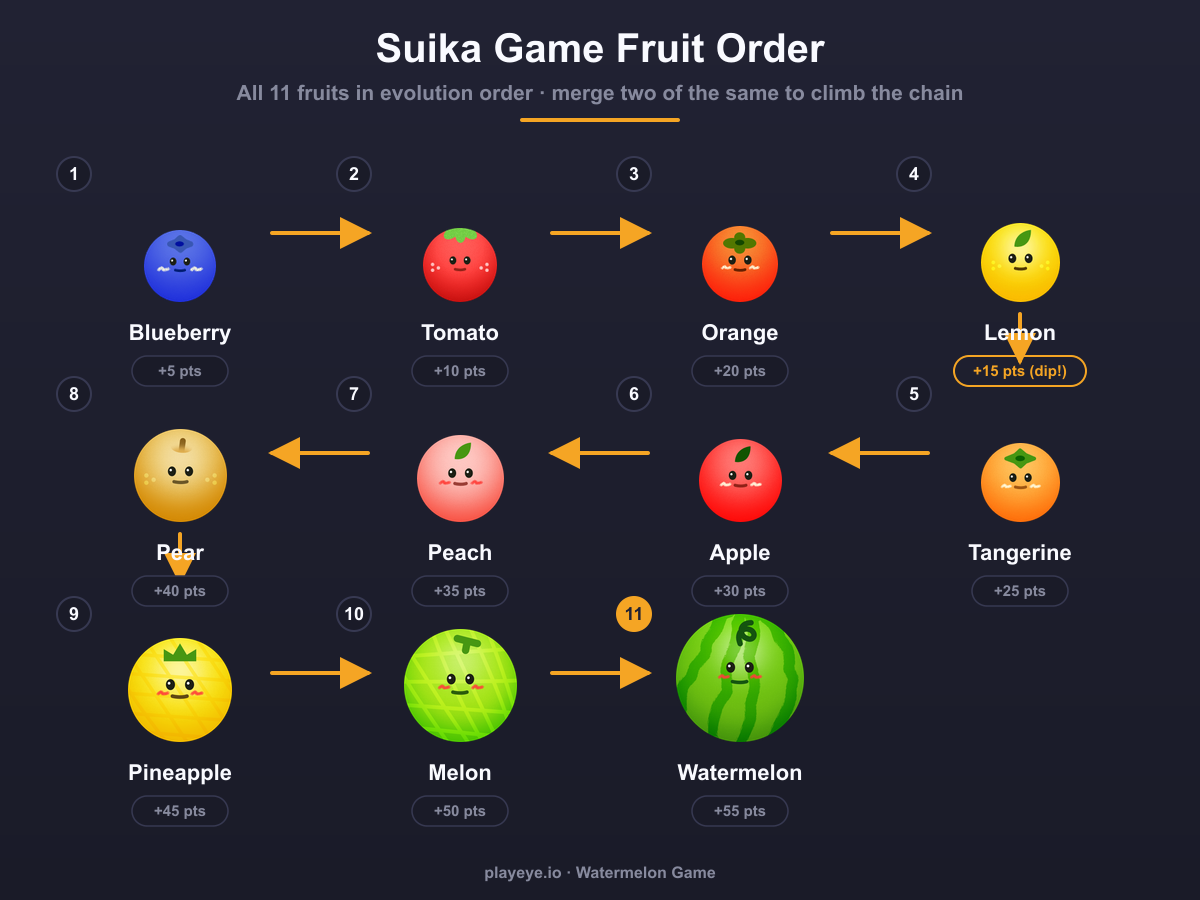
That order is fixed. It never shuffles, never changes between rounds. Learn it once and you stop playing reactively — you start seeing two oranges and already knowing the lemon they'll become and where it should go. That's the difference between flailing and building.
The full evolution chart
Every merge is worth points, and the points are not what you'd guess. Here's the complete chain, with the score you bank each time two fruits combine into that fruit:
| Step | Fruit | Merge points | Notes |
|---|---|---|---|
| 1 | Blueberry | 5 | The starter. You'll drop a hundred of these. |
| 2 | Tomato | 10 | Two blueberries. Double the points, technically a fruit. |
| 3 | Orange | 20 | The curve looks clean so far. Enjoy it. |
| 4 | Lemon | 15 | Read that again. The lemon pays less than the orange below it. |
| 5 | Tangerine | 25 | Order restored. Back on the up-and-up. |
| 6 | Apple | 30 | Mid-board real estate. These eat a lot of space. |
| 7 | Peach | 35 | If you're seeing peaches, you're doing fine. |
| 8 | Pear | 40 | The golden one with the stem. Getting heavy now. |
| 9 | Pineapple | 45 | The crown's earned. Few rounds get here. |
| 10 | Melon | 50 | One merge from the summit. Heart-rate territory. |
| 11 | Watermelon | 55 | The top. Merge two of these and they vanish for a huge bonus. |
A few of those numbers deserve a second look.
5, then 10, then 20. The early game doubles, then the pattern just quietly gives up. Don't try to do mental math off the first three fruits — it lies to you about the rest.
15 for the lemon. This is the one that trips people. Step 4 pays less than step 3. The orange gives you 20, you merge two of them, and the lemon hands back 15 — a dip, right in the middle of the early climb. It's not a bug; it's just how the points were set. The takeaway: you are not climbing this chain to farm points per merge. The points come from volume and from the giant merges up top, not from babying any single fruit. Chase the watermelon, not the per-merge payout.
55 at the top, and then they disappear. The watermelon is worth 55 like everything else follows the +5 trend up there — but the real money is the move after. Two watermelons touching is the game's jackpot: they clear off the board and dump a pile of points, freeing the space you've been suffocating in. It's the only fruit whose best outcome is leaving.
How to actually reach the watermelon
Knowing the order is the entry fee. Surviving long enough to use it is the game. Here's what actually moves the needle.
Build a staircase, not a pile. Keep your biggest fruit parked against one wall and let sizes step down across the board toward the drop zone. Big on the left, small on the right (or flip it — just pick a side). A sorted board gives merges room to happen; a random pile just stacks toward the ceiling.
Pick a corner for the giants and never move it. The pineapple, melon, and watermelon are enormous. Decide early which corner is their retirement home and feed everything toward it. Fighting your own big fruit for center space is how good runs die.
Never park a big fruit in the middle. Center real estate is where new fruit lands. Block it with an apple and you've cut your board in half — small fruit can't reach its partners and you're stuck dropping into a shrinking gap. The middle stays open for traffic.
Let the small stuff chain. Drop a blueberry next to a blueberry and you often get a free cascade — tomato forms, nudges into another tomato, orange forms, and so on. You don't engineer these; you set them up by keeping like-sizes near each other and letting physics collect the debt. A single good chain can clear a quarter of the board.
Respect the 85% line. Fruit stacks toward a warning line near the top of the jar, and in our game that line sits at 85% of the play height. Touch it and the timer to game over starts. Treat 85% as a hard ceiling, not a suggestion — when you're near it, every drop should be a merge you're confident in, not a hopeful toss into the void.
Drop for the merge, not the gap. The instinct under pressure is to fill empty space. Wrong instinct. A fruit that lands without merging is a fruit that made your board taller for zero points. When the board's tight, only drop when you can see the match it completes.
Save the watermelon merge for when you're drowning. Two watermelons clearing is your panic button — it opens up the most space of any move in the game. If you're sitting comfortably, you don't need to rush it. If you're scraping the 85% line, that's exactly when getting two melons to become two watermelons to become nothing is worth every risk.
Plan one fruit ahead. You can see your next drop. Use it. The board you're looking at isn't the puzzle — the board plus the next fruit is. Placing the current fruit to set up the next one is the single habit that separates a 2,000-point run from a 20,000-point one.
Why the fruit order matters more than it looks
Most players treat Suika Game as a reflex game — see fruit, drop fruit, hope. It isn't. It's a sorting puzzle wearing a physics costume. The fruit order is the rulebook for that puzzle, and once it's memorized, the screen reads completely differently: you stop seeing "an orange" and start seeing "half a lemon." You stop seeing a messy board and start seeing which merges are one nudge away.
That mental shift — from reacting to building — is the whole reason a 20-second game eats your evening. If you want to feel it, the Watermelon Game is right here, no download, and it runs the exact 11-fruit chain in this chart. And if you've ever wondered why you can't put it down — why "one more drop" is a lie every single time — we took that one apart in how merge puzzle games hook your brain.
FAQ
What's the fruit order in Suika Game?
Smallest to largest: blueberry, tomato, orange, lemon, tangerine, apple, peach, pear, pineapple, melon, watermelon. Eleven fruits total. Merging two of the same fruit produces the next one up the chain, and the order never changes between rounds.
What's the highest fruit in Suika Game?
The watermelon. It's the eleventh and final fruit, and nothing comes after it. The catch: merging two watermelons together doesn't make a twelfth fruit — they clear off the board entirely for a large bonus and free up space, which is the best move in the game when you're running out of room.
How do you get the watermelon in Suika Game?
You climb the whole chain. Two melons (step 10) merge into a watermelon (step 11). To get two melons you need four pineapples, which means eight pears, and so on all the way down. Practically, you get there by sorting your board — biggest fruit in one corner, sizes stepping down toward the drop zone — and keeping the stack under the 85% warning line long enough for the big merges to land.
Is there an end to Suika Game?
There's no win screen, no final level. The watermelon is the ceiling, and the game ends when fruit stacks past the top line. So "finishing" really means surviving — racking up watermelons and clearing them for points until the board finally fills up. It's an endless climb, which is exactly why the high score is the only thing that matters.
Why does the lemon score less than the orange?
Because the points aren't a clean climbing curve. In our game the orange (step 3) pays 20 and the lemon (step 4) pays 15 — a deliberate dip. The lesson isn't to avoid the lemon; it's that you don't win by farming any single fruit's merge points. Points come from volume and from the huge merges near the top, so chase the watermelon and let the per-merge numbers sort themselves out.