You meant to play for two minutes. The rules took four seconds to learn: drop a fruit, two of the same touch and merge into the next one up, repeat. Easy. Harmless. And then you look up and it's twenty minutes later, the kettle's gone cold, and you hear yourself say "one more" out loud to an empty room.
We've all been there — we built the thing and we still lose afternoons to it. So instead of hand-waving about "the merge loop" like every other explainer, we'll just open the hood. We made the Watermelon Game that runs on PlayEye, which means we can show you the exact chain, the exact scores, and the exact danger line that conspire to keep your thumb moving. Here's what's actually under there, and why it works on you.
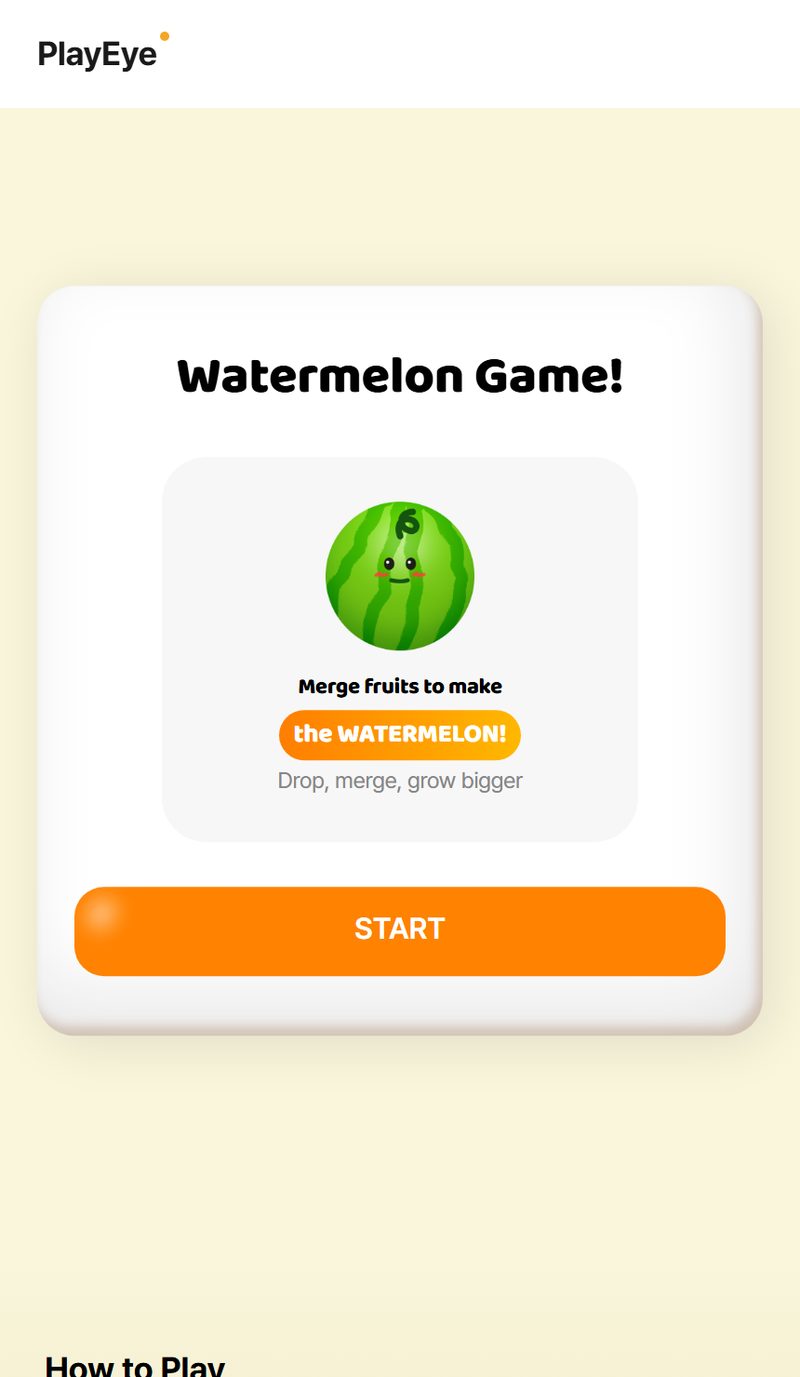
The chain: 11 fruits, and a score table that isn't a clean ramp
Our fruit chain is 11 levels deep — eleven distinct fruits from the smallest up to the watermelon crowning the top. Every successful merge pays out points, and here's the real table straight from our code:
| Level | Score | Level | Score |
|---|---|---|---|
| 1 | 5 | 7 | 35 |
| 2 | 10 | 8 | 40 |
| 3 | 20 | 9 | 45 |
| 4 | 15 | 10 | 50 |
| 5 | 25 | 11 | 55 |
| 6 | 30 |
Look closely and you'll catch something that doesn't belong on a tidy staircase: level 3 pays 20, and then level 4 drops to 15 before climbing again. That's not a typo and it's not a bug. It's tuned that way on purpose. The early fruits are common and merge constantly, so a small non-linear wobble in their values stops the score from feeling like a predictable escalator. Your brain is alarmingly good at noticing when a reward is exactly proportional to effort — and the moment it notices, it stops caring. A slightly irregular payout keeps each early merge feeling like its own little event instead of loose change. From level 5 up the scores climb cleanly by 5s to the 55-point watermelon, so the big merges stay reliably, satisfyingly big.
The merge loop is a tiny dopamine machine
Merge games run on one of the most dependable feelings in all of game design: taking two small things and making one bigger thing. That's it. That's the engine. What makes the merge version special is that the reward chains — drop one fruit, it triggers a merge, which nudges a neighbor into a second merge, which knocks over a third. One well-placed drop can cascade way further than you planned.
And with our score table, a cascade isn't just pretty — it's a points event you can feel land. Three early merges in a row are worth almost nothing apiece (5, 10, 20), but watching the score tick up, up, up from a single drop is the "wait, that did more than I expected" hook firing in real time. Your brain files it as a small win it didn't entirely earn — which is precisely the kind of win it will get up at 2 a.m. to chase again.
Physics makes every drop different
Here's the part people underrate completely: the fruit moves. It rolls. It settles. It shoulders its neighbors out of the way. The board is never once a clean grid.
This matters more than it looks, because it means you can never fully solve the game. A grid puzzle has an answer you can in principle calculate. A physics merge game gives you a plan — which the physics then cheerfully half-ignores. You aim for the gap on the left, the fruit clips a curve, rolls right, and parks somewhere you never intended. Now you've got a fresh problem you didn't make. That gap between intention and outcome keeps the game from ever feeling routine — and, crucially, it hands you something to blame that isn't yourself. So you shrug and try again. And again.
The board fills up, and that's the genius
Most casual games are about going up. Merge games are sneakier than that: they're about staving off going up. The container has a ceiling — in our build the danger line sits at 85% of the container height before the game starts warning you — and every fruit you drop and fail to merge nudges the pile closer to it.
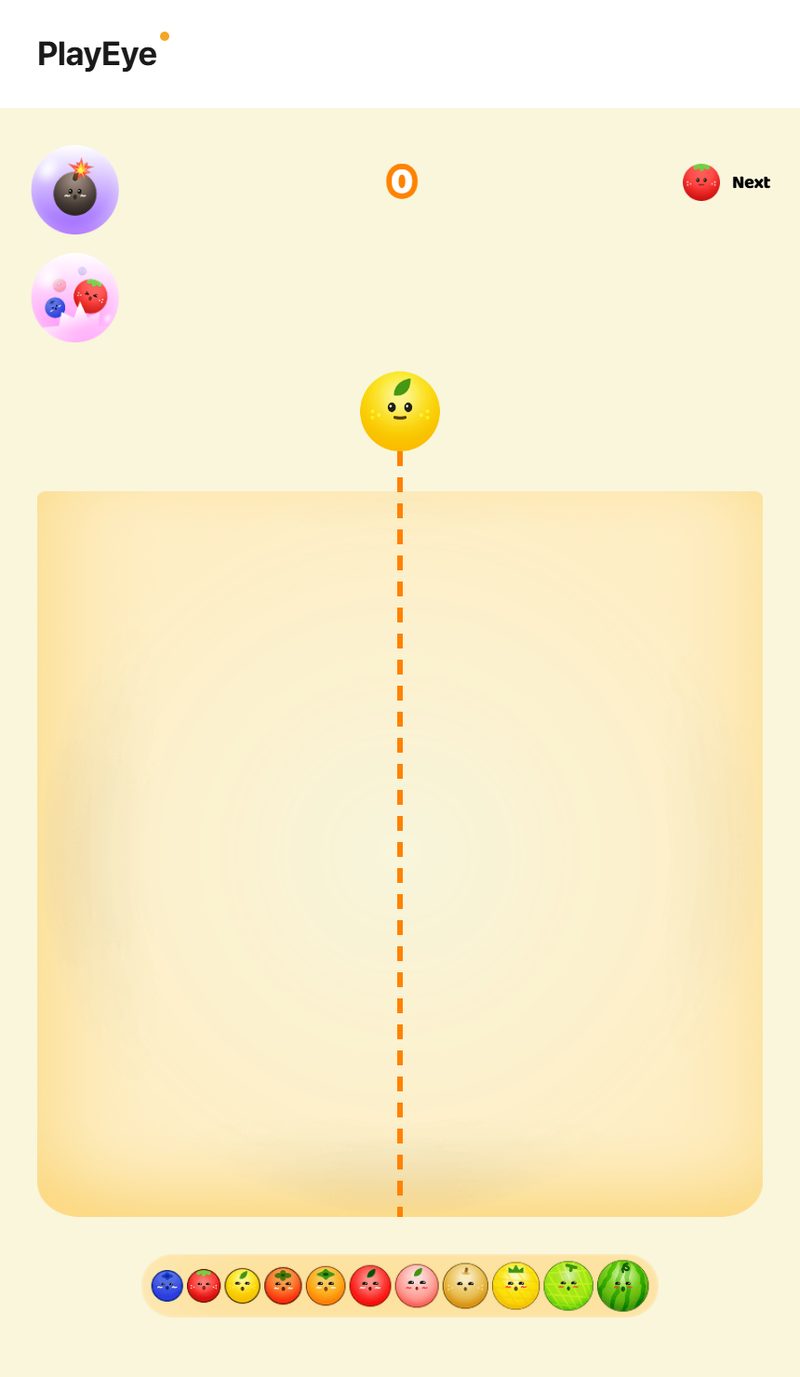
So you're quietly playing two games at once, and they're at war. The fun game is climbing toward the watermelon. The tense game is not crossing that 85% line. And they fight, because the big fruits you want most are the ones that eat the most space. That squeeze is the exact same tension that powers Tetris, and it's why the calmer, slower board management in Farm Farm Tile scratches a cousin of the same itch — same "clear it before it buries you" family, lower heart rate.
The escape hatches that make the squeeze fair
A rising-pile game can tip from tense into hopeless in about two bad bounces, and a hopeless board is a closed tab. So we hand you two optional pressure valves — power-ups you can fire when things get ugly:
- Pop — destroy any single bubble you choose. The surgical option: blow up the one badly-placed fruit that's wrecking your whole stack.
- Clear small bubbles — sweep out the little low-level fruits cluttering the bottom and buy back room.
These exist for one reason: a near-miss only feels good if survival was genuinely on the table. Strip out the relief and a rough run of physics becomes an unwinnable board, and an unwinnable board becomes a quit. With them, a desperate save is yours — you picked the bubble, you timed the clear, you pulled it back. That's what keeps the tension on the right side of the line between thrilling and infuriating.
The near-miss keeps you coming back
The most powerful moment in a merge game isn't the win. It's the almost. The pile creeps to the line, you drop one fruit with your whole body tense, two big ones merge, the entire stack collapses downward, and you've just bought yourself another minute. You didn't win anything. You survived. And somehow that feels better than winning.
Game psychologists call this the near-miss effect — the same mechanism that makes slot machines impossible to walk away from. But there's one crucial difference, and it's the difference between a fun game and a predatory one: in a merge puzzle the near-miss is genuinely the result of your skill — and now your power-up timing — not a rigged animation designed to fake it. You actually pulled it back. That earned tension is what makes the loop feel rewarding instead of cheap.
The chain is a tease you can see coming
One last trick, and it's an old one. The genre shows you the goal you'll almost never reach. Our 11-fruit ladder is laid out in front of you from the very first drop — you can see the watermelon sitting at the top, even though merging all the way up to it takes a near-perfect run you'll rarely get. Every merge stops being a random reward and becomes a step on a known path. You're not just scoring; you're climbing toward a specific, pictured prize that's 55 points and eleven rungs away.
That's a quiet trick borrowed from the oldest progress bars in games: show players exactly how far they could go, and most of the motivation handles itself. Learn it once in four seconds, and our Watermelon Game keeps paying out for as long as you're willing to say "one more." Which, fair warning, is longer than you think.