
- Genre
- Match-3 Tile Puzzle
- Play time
- 3-7 minutes per stage
- Best for
- Calm puzzle moments
- Platform
- Mobile web, no install
About
There's a small farm on your screen, and someone has scattered it with vegetables. Your job is to sort them out, three at a time, before the bottom slot fills up and the morning ends.
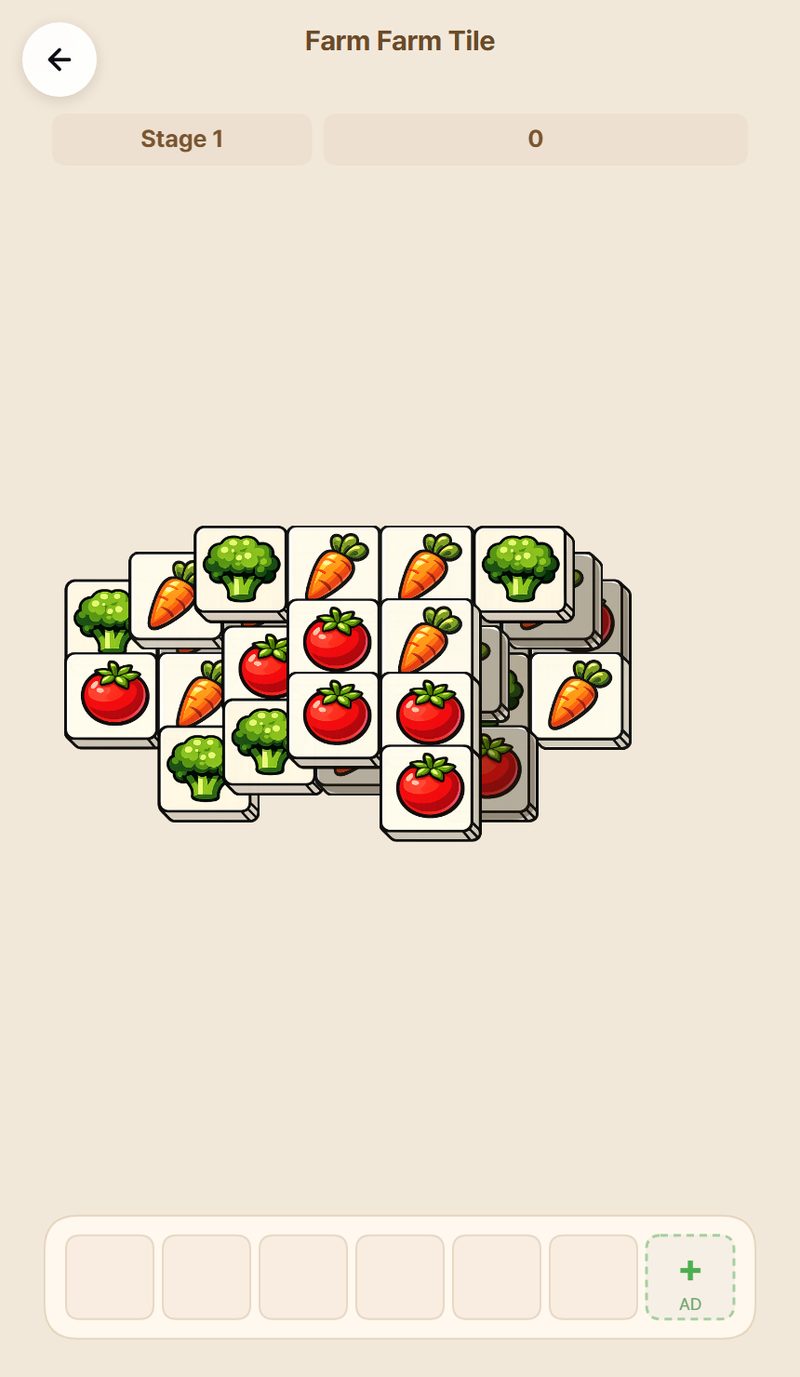
Farm Farm Tile is a clean, focused take on the tap-and-sort puzzle. The field is full of overlapping tiles — carrots, broccoli, tomatoes, grapes, watermelon, oranges. You tap one and it slides down into a seven-slot tray at the bottom of the screen. Line up three of the same kind and they vanish together with a soft pop. Get careless, let the tray fill up with mismatched pieces, and the round is over.
The pleasure here is in the planning. Easy stages reward simple sweeps. Later ones layer the field, hide tiles under tiles, and tempt you into tapping the most visible piece instead of the most useful one. There are twenty stages in total, divided evenly across four difficulty tiers — Easy, Normal, Hard, and Expert — and each one unlocks in order. The early hours feel like a warm-up; the Expert set is where the puzzle reveals what it's really about.
It's a good fit for anyone who likes the 3 Tiles formula and the short, self-contained loops of mobile-first puzzlers. The art keeps things soft and friendly: a sunlit farm, rounded illustrations, no flashing alarms when things go wrong. The challenge sits in the design of the boards, not in pressure or noise. Play a stage between emails. Replay it on the train. Move on when it clicks.
Because the seven-slot tray is the only thing standing between you and a clear board, every tap is a small decision about space. Take the wrong tile and you spend a slot on a vegetable you can't yet complete; take the right one and you open up the pieces beneath it. That tension — limited room, full field — is what turns a simple matching game into a genuine puzzle. The difficulty tiers don't add noise or timers; they just lay the boards out more cunningly, so the same gentle rules keep producing harder and more satisfying problems all the way to Expert.
How to Play
- Tap any visible tile on the farm to move it into the seven-slot tray
- Collect three matching vegetables in the tray to clear them automatically
- Keep the tray from filling up — seven mismatched tiles ends the stage
- Plan around layered boards by clearing the tiles blocking the ones you actually need
- Progress through twenty stages across Easy, Normal, Hard, and Expert tiers
Tips & Strategy
- Protect your tray slots. The seven slots are your real resource. Avoid pulling a lone tile you can't complete soon — every "orphan" piece shrinks the room you have to work with.
- Hunt for pairs before triples. Look for vegetables that already have two of a kind available on the field. Completing near-finished sets frees slots fast and keeps the tray breathing.
- Clear the blockers. The most visible tile is rarely the most useful. Prioritize tiles that are covering the pieces you actually need underneath them.
- Think one match ahead. Before tapping, picture which slot the tile fills and what it unlocks. A little planning prevents the slow pile-up that ends most lost rounds.
- Replay early stages to read patterns. The Easy and Normal boards teach the layouts the Expert tier reuses in trickier forms. A confident warm-up makes the hard stages far more readable.
How the Tray Works
Tap any tile on the farm and it slides down into the tray at the bottom of the screen. Collect three of the same vegetable in the tray and they clear together automatically, freeing the slots they used. The whole game is a balancing act between feeding tiles into a limited tray and clearing them before that tray fills up.
That tray is the heart of the challenge: it holds seven slots (six by default, with a seventh opened up as an optional expansion). Fill every slot with mismatched, un-completable tiles and the stage is lost. There's no timer — the only pressure is space.
One detail the game rewards you for noticing: when you tap a tile, it's tucked into the tray next to any matching vegetables already there, not just dumped on the end. So the tray auto-sorts itself, which means a near-complete trio stays grouped and ready to pop the moment you find its third.
Blocked Tiles and the Layered Board
Tiles are stacked in layers, and a tile is blocked whenever another tile on a higher layer overlaps it by about a third or more. Tap a blocked tile and it just shakes — it won't move into the tray. You have to clear whatever's sitting on top of it first.
This is what turns a simple matching game into a real puzzle. The most visible, tempting tile is often the least useful one, because the vegetables you actually need are hidden underneath it. Reading the stack — figuring out which tile unlocks two more beneath it — is the core skill.
Progression: 20 Stages, Four Tiers
The game runs 20 stages, unlocked in order and grouped into four difficulty tiers. The boards scale in a very deliberate way:
- Stage 1 ("Garden Basics") uses just three vegetables — carrots, broccoli, and tomatoes — in a small, gentle three-layer butterfly shape. It's a pure tutorial for the tap-and-clear rhythm.
- From Stage 2 on, the variety jumps to a wide roster (up to thirteen produce types — grapes, watermelon, oranges, lemons, cherries, strawberries, mushrooms, peppers, eggplant, corn, and more), and boards are built from clusters in different shapes (circles, diamonds, triangles, crosses, rings, hexes).
- The board deepens steadily: early stages stack around five layers, while the toughest late stages pile tiles up to fourteen layers high, with total tile counts climbing from under a hundred to well over two hundred.
Tile counts are always multiples of three, so every board is solvable in principle — the difficulty is entirely about order, not luck. Match in quick succession and combo scoring kicks in: a single match is worth 100, but chaining a second and third match without pause bumps each to 150 and then 200.
Smart Tile Play
- Guard your slots like currency. With only six or seven, every tile you pull without a near-term match is a slot you can't get back until you complete a trio. Avoid tapping lone vegetables you have no plan to finish.
- Finish pairs before starting new sets. Scan for vegetables that already have two copies sitting in the tray or easily reachable on the board. Closing those out frees slots immediately and keeps the tray breathing.
- Tap the blockers, not the bait. The tile on top isn't the goal — it's the obstacle. Prioritize removing whatever is covering the pieces you actually want underneath.
- Read one move ahead. Before each tap, picture which tray slot the tile lands in and which tile it exposes on the board. A little forethought prevents the slow pile-up of orphan tiles that ends most lost stages.
- Chain your matches for combo points. Lining up several completions back-to-back not only clears the board faster but escalates the score from 100 up to 200 per match — so clustering your clears pays double.
- Replay the easy tiers to learn shapes. The cluster shapes the early stages introduce (diamonds, rings, crosses) come back layered and disguised in the Expert boards. A confident warm-up makes the hard layouts far more readable.
Frequently Asked Questions
How many tray slots do I have?
Six by default, with a seventh slot available as an optional expansion. Those slots are your entire working space, so the whole game is about not wasting them.
Why won't a tile move when I tap it?
It's blocked — another tile on a higher layer is covering it by roughly a third or more, and it just shakes instead of sliding down. Clear the tile sitting on top of it first.
Are the boards always solvable?
Yes. Every stage lays out tiles in multiples of three, so a perfect sequence of taps always exists. Losing comes from clogging the tray with the wrong order, not from an impossible board.
Do the stages get harder, or just different?
Harder. Across the 20 stages the vegetable variety grows, the boards stack more layers (from a few up to around fourteen), and the total tile count rises past two hundred — while the gentle rules stay the same.