
- Genre
- Observation Puzzle
- Play time
- 1-5 minutes per run
- Best for
- Sharpening your focus
- Platform
- Mobile web, no install
About
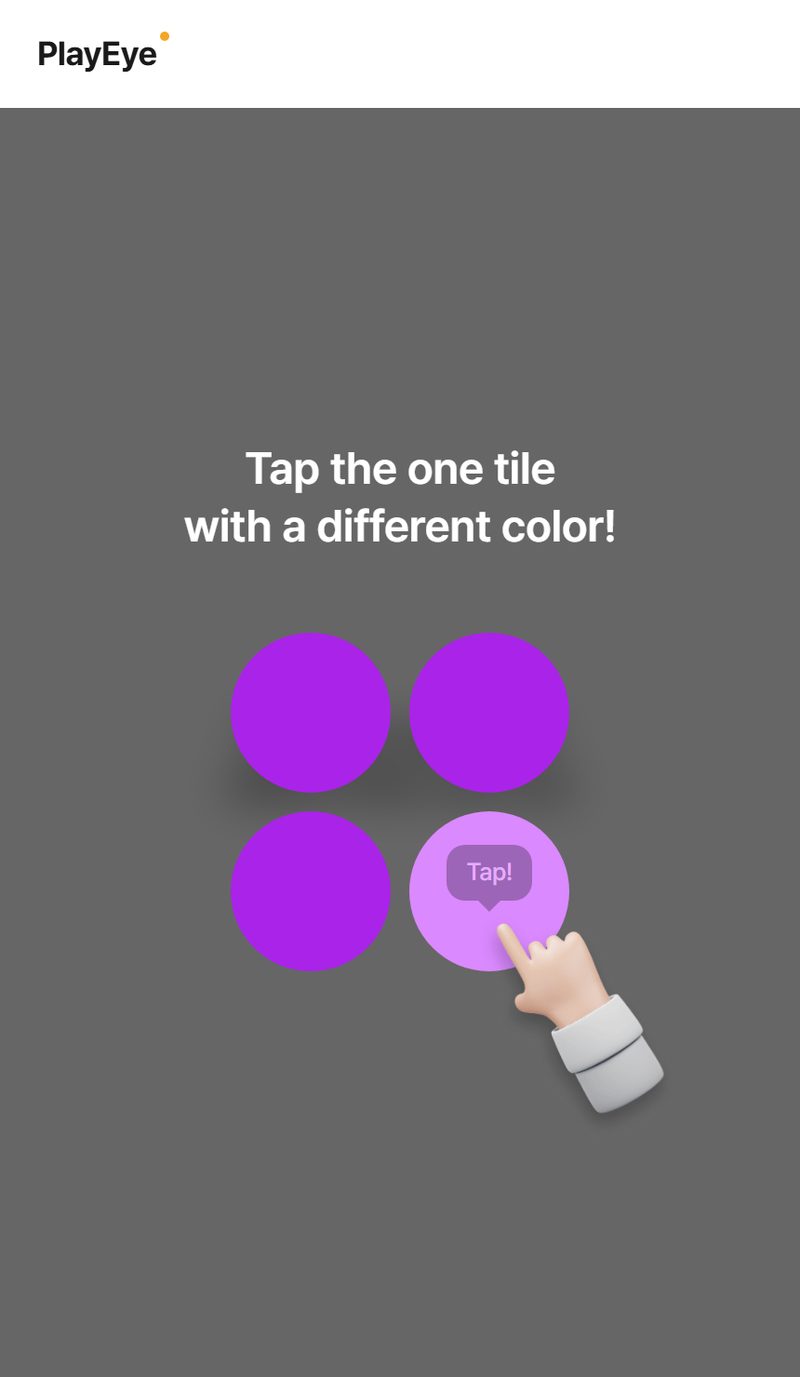
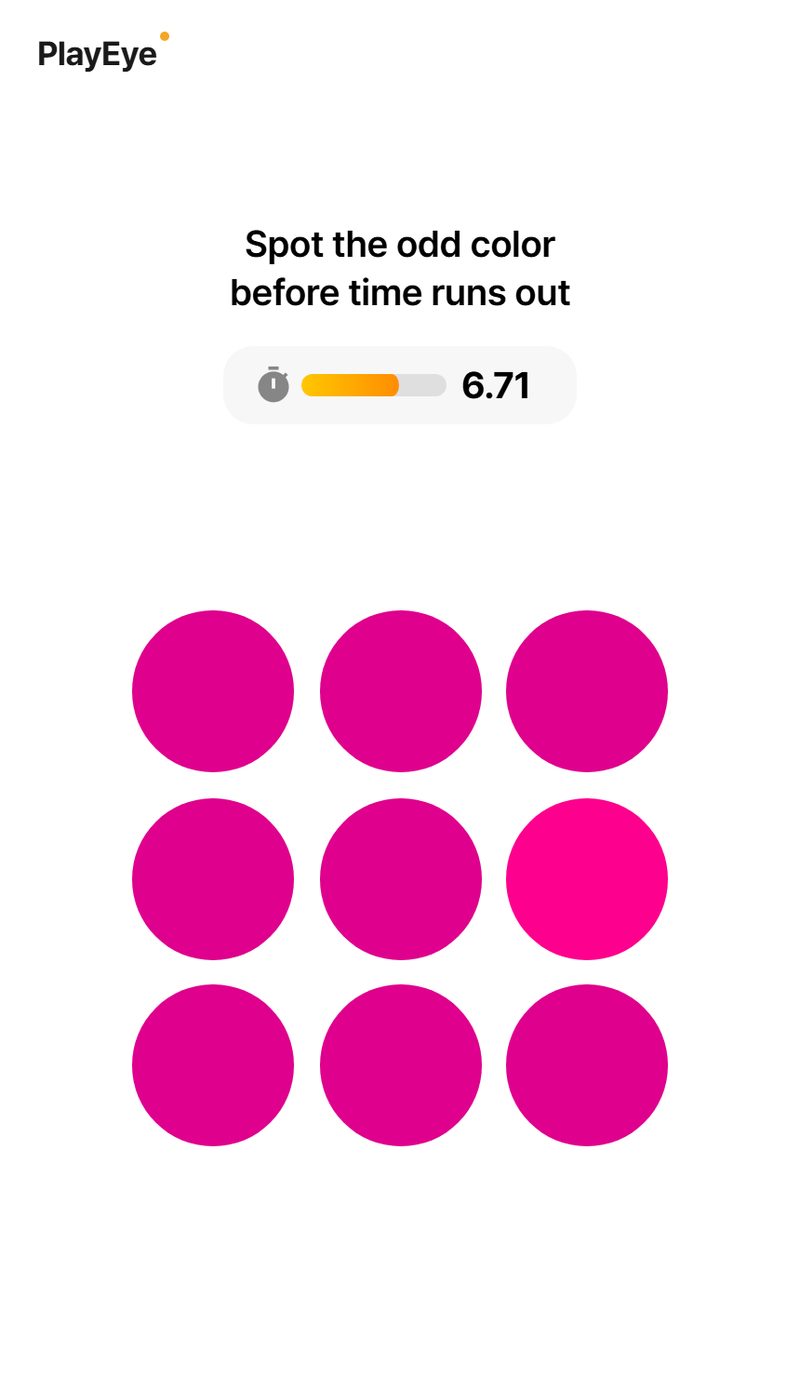
Odd Color Out is an observation puzzle stripped down to one pure challenge: find the tile that doesn't match. The screen fills with a grid of identical-looking colored squares — except one of them is a slightly different shade. Tap that odd tile out before the timer runs out, and you advance to the next, trickier round.
It starts gentle. The first grids are small and the odd color is easy to spot, almost obvious. But with each level the grid grows, the squares get smaller, and the difference in shade narrows until you're squinting at two colors that look, at a glance, exactly the same. What began as a casual glance becomes a genuine test of how carefully your eyes can read color — the kind of subtle challenge that feels easy until suddenly it isn't.
The timer keeps every round honest. You can't simply scan forever; you have to commit to what you see and tap, which adds a satisfying pulse of pressure to an otherwise calm game. Spot the odd tile quickly and you bank time and momentum. Hesitate too long and the round slips away. It's a clean, fair loop that rewards a steady eye and a confident tap.
Because each round is bite-sized, Odd Color Out is easy to dip into for a single quick challenge or to push level after level to see how fine a difference you can detect. It's a quiet, focused kind of fun — no noise, no clutter, just you and a grid of color daring you to find the one that's out of place. A great little palate-cleanser for the eyes between heavier tasks.
How to Play
- Look over the grid of colored tiles as soon as the round begins
- One tile is a slightly different shade than all the others — find it
- Tap the odd tile before the timer runs out to clear the round
- Each level adds more tiles and makes the color difference subtler
- Keep clearing rounds to see how fine a difference your eyes can catch
Tips & Strategy
- Scan in a pattern, not at random. Sweep your eyes row by row or in quarters so you cover the whole grid once cleanly instead of bouncing around and rechecking the same tiles.
- Look for the outlier, not the "right" color. Don't try to memorize the base shade. Let your eye catch the one tile that pops slightly — it'll often jump out before you can name why.
- Use soft focus on big grids. When the grid is large, relax your gaze and take in the whole board at once; the odd tile tends to surface as a faint difference in the overall texture.
- Commit once you see it. Second-guessing burns the clock. The moment a tile feels different, tap it — your first instinct is usually right.
- Mind screen glare and brightness. Subtle shades are easier to read on a clean screen at a comfortable brightness, so a quick adjustment can buy you the edge on the hardest levels.
What You're Actually Looking For
The screen fills with a grid of squares that all share one color — except a single tile is painted a slightly different shade. Tap that one odd tile before the round's clock runs out, and you advance. Tap the wrong tile, or let time expire, and the round ends.
Every round gives you a 10-second countdown. That's plenty on the easy grids and almost cruel on the hard ones, which is the whole tension of the game: you have to commit to what your eyes are telling you instead of endlessly second-guessing.
How the Difficulty Climbs
The challenge ramps on two axes at once across a four-level ladder — the grid grows and the color difference shrinks:
- Level 1 — 3x3 (9 tiles). The odd tile differs by a clearly visible amount (think a shift of around 30 steps in one color channel). Easy to spot at a glance.
- Level 2 — 4x4 (16 tiles). More tiles to scan, with differences in the same ballpark but spread across a busier board.
- Level 3 — 5x5 (25 tiles). The grid is denser and the gaps between shades start narrowing, so the outlier no longer "jumps out."
- Level 4 — 6x6 (36 tiles). The hardest tier: the odd tile may differ by as little as ~10 steps in a single channel, on a 36-square board. At this point you're hunting a difference most people can barely name.
Clear the top level and the ladder loops back to the gentle 3x3, so a sharp-eyed player keeps cycling the gauntlet. Each level is a fresh round with its own 10-second clock and a randomly placed odd tile, so you can never memorize where to look.
Tips for Sharper Spotting
- Sweep methodically, don't dart. On bigger grids, scan row by row or in quadrants so you cover every tile exactly once. Random bouncing makes you re-check tiles you've already cleared and burns the clock.
- Hunt the outlier, not the "true" color. Don't try to memorize the base shade and compare each tile to it. Let your peripheral vision catch the one square that feels slightly off — it often registers before you can consciously explain why.
- Soft-focus the whole 6x6. On the hardest grid, relaxing your gaze to take in the entire board at once works better than staring at individual squares. The odd tile tends to surface as a faint ripple in the overall texture.
- Commit on first instinct. When two shades differ by ten steps, hesitation rarely improves your guess — it just drains the 10 seconds. The moment a tile feels different, tap it.
- Mind your screen. Subtle shade differences are far easier to read on a clean display at moderate brightness. Glare or a very dim screen can hide the exact gap the hardest level is testing.
- Use the early levels to calibrate. The 3x3 and 4x4 rounds tune your eyes to the kind of difference you're chasing before the 5x5 and 6x6 make it brutal. Don't rush through them carelessly.
Frequently Asked Questions
How much different is the odd tile, really?
It varies by level. On the first level the difference is obvious — roughly a 30-point shift in one color channel. By the hardest level it can be as little as a 10-point shift across 36 tiles, which is near the edge of normal color perception.
How long do I have each round?
Ten seconds. The clock is the same on every level — what changes is how hard the tile is to find within it, so those ten seconds feel generous early and razor-thin late.
Does the grid keep getting bigger forever?
It tops out at a 6x6 grid on the fourth level, then the ladder loops back to the 3x3 starting size. The difficulty resets in size but you're expected to keep clearing the cycle.
Is this good for training my eyes?
It's a genuine workout for color discrimination — the skill of telling near-identical shades apart. The looping difficulty means you can keep pushing your perception right up to its limit.