You swung. You swear you swung in time. The mole dropped anyway, and somewhere a counter ticked up one, and you sat there briefly convinced the game cheated you. It probably didn't. What beat you was a number you've never seen — a window measured in milliseconds, small enough that "in time" and "too late" are separated by less than a blink.
Most games keep that number hidden. We can't hide it from ourselves: we wrote it. So we opened the source and read the exact values straight out, and here they are — the real windows you're actually playing against, not a vibe.
This is the stuff a generic "can arcade games improve your reaction time?" post physically cannot give you, because it has no idea what's inside any specific game. We do. It's our game.
Whack-a-Mole: from 400 ms down to 300, and from 3 misses down to 1
Whack-a-Mole runs on two dials, and both tighten as you climb: how long a mole stays whackable, and how many misses you're allowed before the run ends. This is the actual ladder, lifted out of our config:
const LEVEL_CONFIG = [
  { totalOpportunities: 3, duration: 400 },
  { totalOpportunities: 3, duration: 350 },
  { totalOpportunities: 2, duration: 350 },
  { totalOpportunities: 1, duration: 300 }
]
Read it as a difficulty curve and it tells a story with a shape:
- Level 1 — a mole is up for 400 ms and you can blow 3 misses. Forgiving on both axes. This is where your hands learn the rhythm and nothing bad happens while they do.
- Level 2 — the window drops to 350 ms, but the miss budget stays at 3. We tighten speed first and leave the safety net alone, so the step up reads as "faster," not "meaner." You barely notice you've been squeezed.
- Level 3 — same 350 ms window, but now you get 2 misses. Nothing got faster. Everything got tenser. The pressure quietly moved from your hands to your nerve.
- Level 4 — 300 ms and a single miss. One slip and it's over. No rhythm to settle into, because you don't get a second one.
That 400-to-300 ms range isn't arbitrary — it's pinned to your actual wiring. Typical simple visual reaction time lands around 250 ms, so a 400 ms window is generous (you'll mostly connect) and a 300 ms window is genuinely demanding (now you're racing your own nervous system) without ever crossing into impossible. We could've made moles flash for 150 ms. We didn't, because a 150 ms window isn't a challenge — it's a coin toss with a hammer, and a coin-toss reflex game is just a slot machine that makes you feel bad.
Stop the Cloud: an accuracy gate that climbs from 70% to 92%
Stop the Cloud is a one-input precision game — a cloud drifts, you tap STOP, you try to land it on a target. Two things tighten as you go: how fast the cloud moves, and how exactly you have to stick the landing. From the source:
const LEVEL_CONFIG = [
  { duration: 3000, targetAccuracy: 70 },
  { duration: 2700, targetAccuracy: 78 },
  { duration: 2400, targetAccuracy: 85 },
  { duration: 2100, targetAccuracy: 92 }
]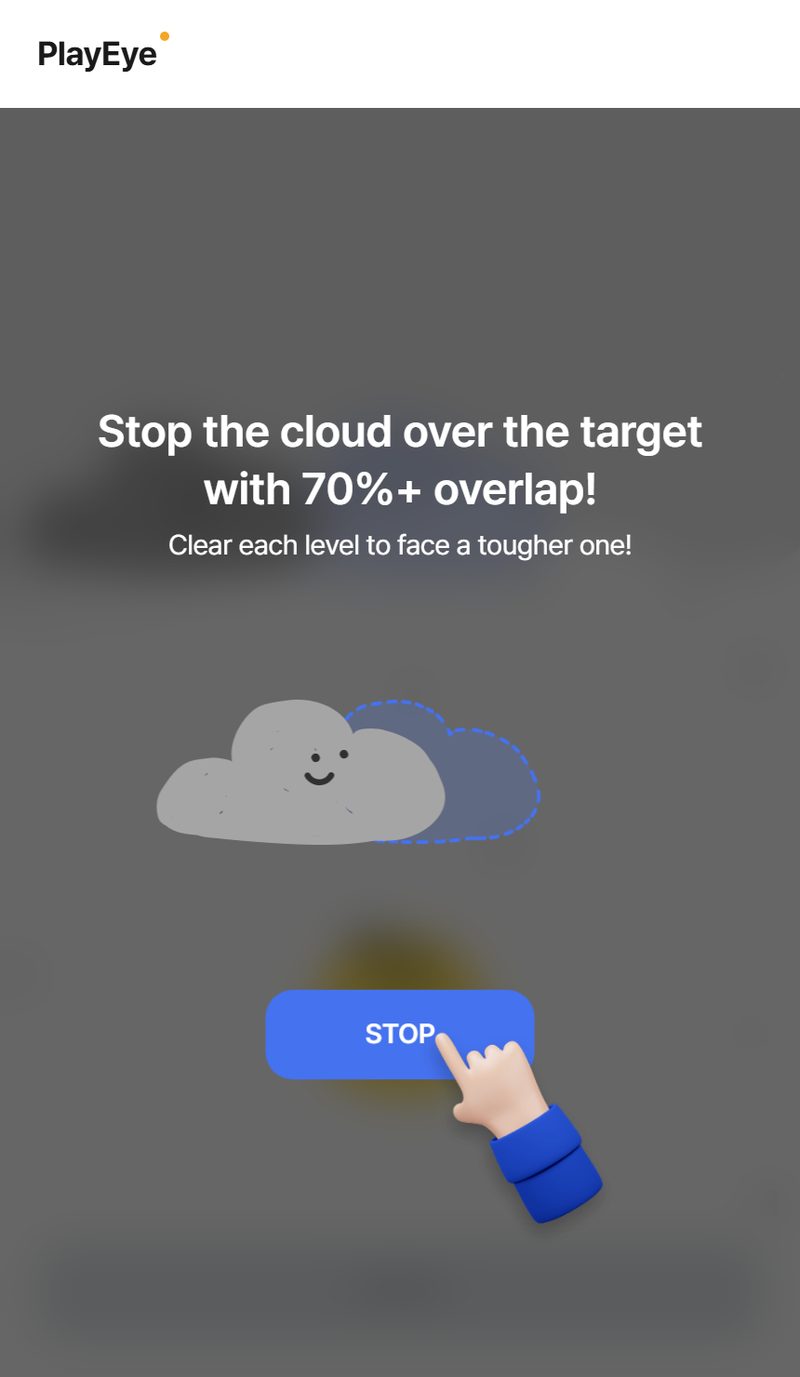
The accuracy number is the real villain here. Accuracy isn't a vibe — it's literally how much of the target your cloud overlaps at the moment you stop it, turned into a percentage:
const rawAccuracy = overlapWidth / targetWidth
const accuracy = Math.round(rawAccuracy * 10000) / 100- Level 1 asks for 70% overlap. Land roughly on the thing and you pass. It's practically waving you through.
- Level 4 wants 92% overlap — while the cloud crosses the screen in 2,100 ms instead of the opening 3,000 ms. So it's moving about 30% faster and demanding a far tighter landing, at the same time.
That's the trick, and it's deliberate: a shorter duration stacked on a stricter gate. Either one alone, you'd handle. Together, the margin for error nearly stops existing. That double-squeeze is the entire design of the top level, and it's exactly why the jump to Level 4 doesn't feel like "harder" — it feels like a different game put on the same screen while you weren't looking.
So — can these actually train your reaction time?
Honestly? The research on whether reflex-game practice transfers to anything outside the game is mixed, and we're not going to stand here and oversell it to you. That would be the generic blog's move, and we'd rather not.
What we can tell you, precisely, is what these games demand — because we wrote the demands down: a 300 ms whack window and a 92% accuracy gate. Those aren't motivational numbers. They're the real targets you're throwing yourself against every run.
And what we actually tuned for isn't a fitness claim — it's fairness. Every one of those windows is set so that with practice you can feel yourself inching toward the edge, instead of face-planting into an impossible wall on rep one. That gradient — beatable but demanding, always just out of reach in a way that pulls you back — is the thing that makes a reflex game worth a second run. And it's the one thing you can only get right by owning the values and testing them yourself, which is the whole reason we can show them to you at all.
Go find your edge: start gentle on Whack-a-Mole, then see how far up the accuracy ladder you can survive in Stop the Cloud.