- Genre
- Classic Arcade
- Play time
- 30 seconds to an hour
- Best for
- Quick reflex, high-score chasing
- Platform
- Mobile web, no install
The Arcade Classic That Lived in Your Pocket
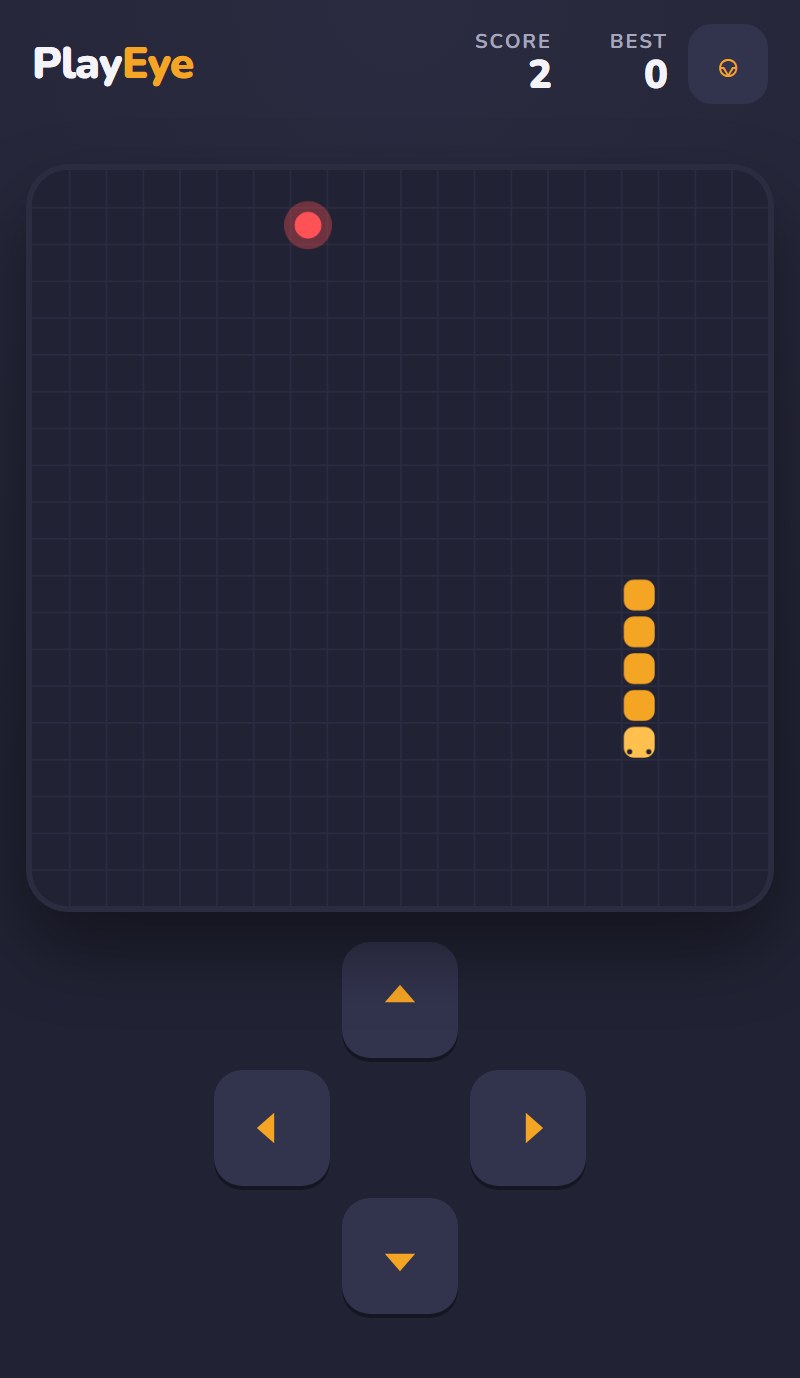
Snake is about as pure as a game gets. You steer a line that never stops moving, eat the dot, and grow a little longer. That's it — and that's exactly why it's still here decades later. The challenge isn't the rule, it's the consequence: every bite you take makes the board a little more crowded with you, until your own tail becomes the thing most likely to end the run.
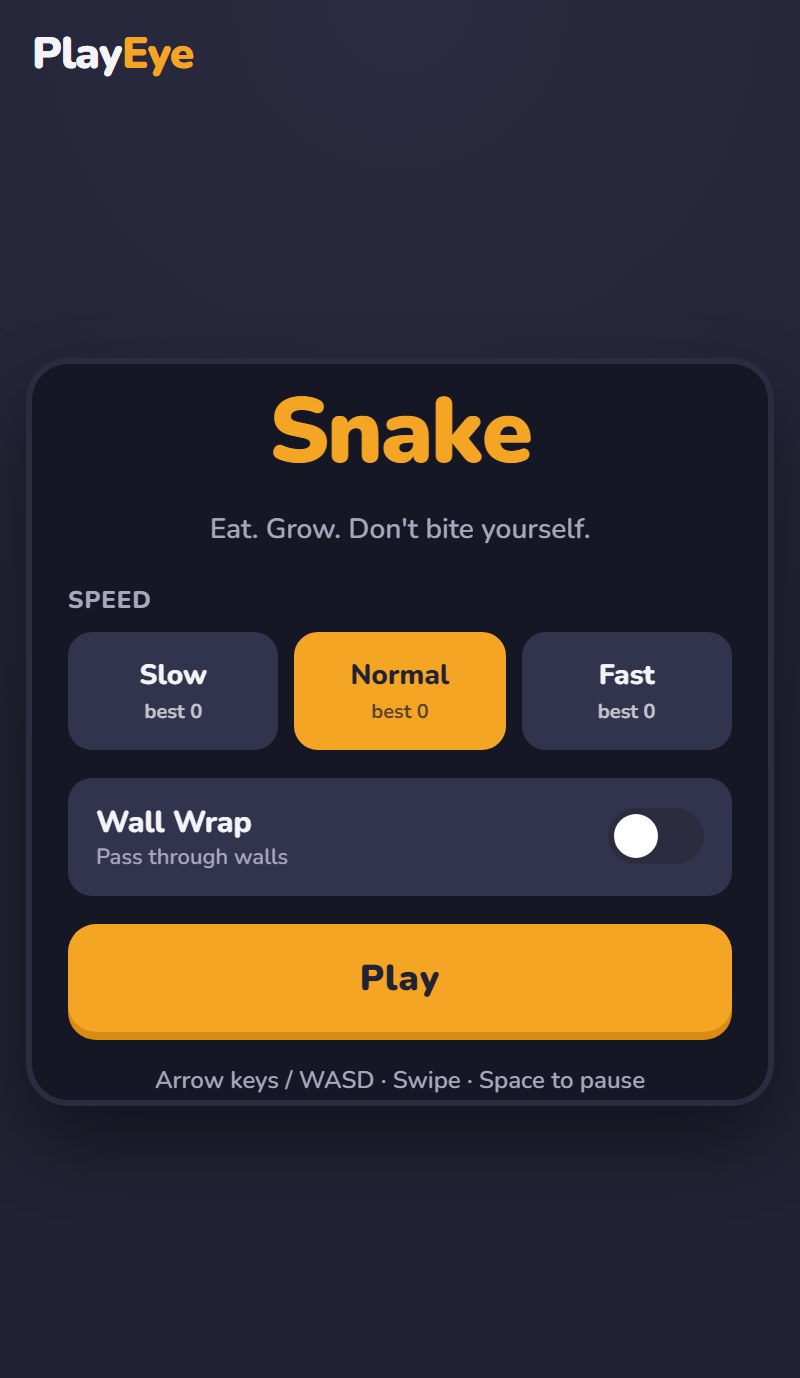
This is the classic Snake game, free in your browser with no download. You can dial the pace with three speeds — Slow, Normal, and Fast — and flip a wall-wrap toggle that decides whether the edge of the board is a deadly wall or a doorway that pops you out the opposite side. Controls work however your hands want them to: arrow keys or WASD on a keyboard, swipes on a touchscreen, or the on-screen D-pad if you'd rather tap. Your high score is saved automatically, so every session is a chance to beat the last one. It's the kind of game you can pick up for thirty seconds or chase for an hour — a genuine snake game online that loads instantly and asks nothing of you but reflexes and a little nerve.
How to Play
- Your snake moves on its own, constantly, in whatever direction it's facing. You only steer; you can't stop.
- Eat the food to grow one segment longer and add to your score.
- Steer with the arrow keys, WASD, a swipe, or the D-pad. You can't reverse directly into yourself — a 180-degree turn is blocked.
- Don't hit your own tail. As you grow, the board fills with your body, and a single self-collision ends the run.
- Walls depend on your setting. With wrap off, touching an edge ends the game. With wrap on, you slide through the edge and reappear on the opposite side.
- Pick a speed before you start — Slow to learn the controls, Fast once you want a real test.
Strategy: Surviving Past the Easy Length
Anyone can score early. The skill is in not trapping yourself once your tail is long enough to matter.
- Don't chase the food in a straight line. The greedy beeline works for the first few bites and gets you killed later. Think about where your tail will be after you eat, not just how to reach the dot now.
- Work the edges, then the perimeter pattern. A reliable technique is to travel along the walls and weave back and forth in tidy rows, covering the board systematically rather than darting across the middle. It keeps your body in predictable lines and leaves open lanes you can read at a glance.
- Always leave yourself an exit. Before you commit to a direction, glance at where it dumps you. The classic death is steering into a pocket your own tail has sealed off, with no room to turn out. If you can't picture the way out, don't go in.
- Use wall-wrap as a tool, not a panic button. With wrap on, the edges become escape routes — you can slip through one side to dodge a tail you'd otherwise crash into. But it cuts both ways: your tail wraps too, so a body segment can be waiting where you reappear. Learn to track it.
- Start slow to build the muscle memory. On Slow, you have time to plan two or three turns ahead. The patterns you learn there carry directly to Fast, where you won't have time to think — only to react. Speed punishes hesitation, so the goal is to make the safe path automatic.
- Keep your turns square and deliberate. Twitchy double-taps and near-instant turns are how you accidentally fold the snake back on itself. Make clean, single, committed turns.
- Manage the late game like a maze you're building. Once you're long, you're effectively drawing the walls of your own labyrinth in real time. Fill space from one side in neat columns or rows so the open area stays one connected region instead of a scatter of dead-end pockets.
- Read the food's position before it appears in your path. When new food spawns near your tail or in a tight corner, plan the approach early rather than swerving for it at the last second.
Where Snake Came From
The idea is older than the phones that made it famous. Its direct ancestor is generally traced to Blockade, a 1976 arcade game by Gremlin, where two players each steered a growing line and tried to outlast the other without crashing — the same "trail that becomes an obstacle" mechanic at Snake's core. Through the late 1970s and 1980s the concept reappeared on home computers under a string of names, a single-player version steadily becoming the dominant form.
Snake's leap to true ubiquity came at the end of the 1990s, when Nokia loaded a version onto its mobile phones. Suddenly a simple, monochrome Snake was sitting in the pocket of an enormous number of people worldwide — for many, it was the first video game they ever played on a phone, and the thing they reached for in any idle moment. That association is so strong that "the Snake game on the old Nokia" is how a whole generation remembers the genre.
Since then Snake has been remade endlessly — bigger boards, color, multiplayer, web versions you'll see described as snake game unblocked because they load anywhere a browser does. The core has never needed changing: move, eat, grow, and try not to run into the snake you've become.
Frequently Asked Questions
Can I run into myself, or only the walls?
Both can end a run, but your own tail is the real danger. Walls only matter when wrap is turned off — and even then, the longer you get, the more the game is about dodging yourself, since your body keeps claiming more of the board.
What does the wall-wrap setting change?
With wrap off, the four edges are solid walls and touching one ends the game — the stricter, classic feel. With wrap on, the snake passes through an edge and reappears on the opposite side, which opens up escape routes but also means your own tail can be waiting where you come out.
Which speed should I play?
Start on Slow to get comfortable with the controls and learn to plan your turns ahead. Normal is the standard challenge. Fast is for when you want pure reflex pressure, where there's no time to think and the safe path has to be automatic.
Does the snake ever stop moving?
No. It's always advancing in its current direction — you steer, but you can never pause the motion or back straight into yourself. That constant forward pressure is the whole tension of the game.
Is there an ending, or does it go forever?
There's no finish line. You play until you crash, so the only real goal is the score, which keeps climbing as long as you survive. Your best result is saved so you always have a number to beat.