There's a stage where people quit. There always is. You build twenty of them, you watch the data come in, and somewhere on that curve there's a wall players hit and just... close the tab. The whole job of tuning difficulty is making sure that wall never shows up — that every stage feels like a step, not a cliff.
In a tile-matching game like Farm Farm Tile, that's harder than it sounds, because difficulty isn't one dial. It's three or four pressures leaning on each other, and the craft is in how they grow relative to one another over twenty stages. Turn the wrong one too fast and you don't get "challenging." You get the quit.
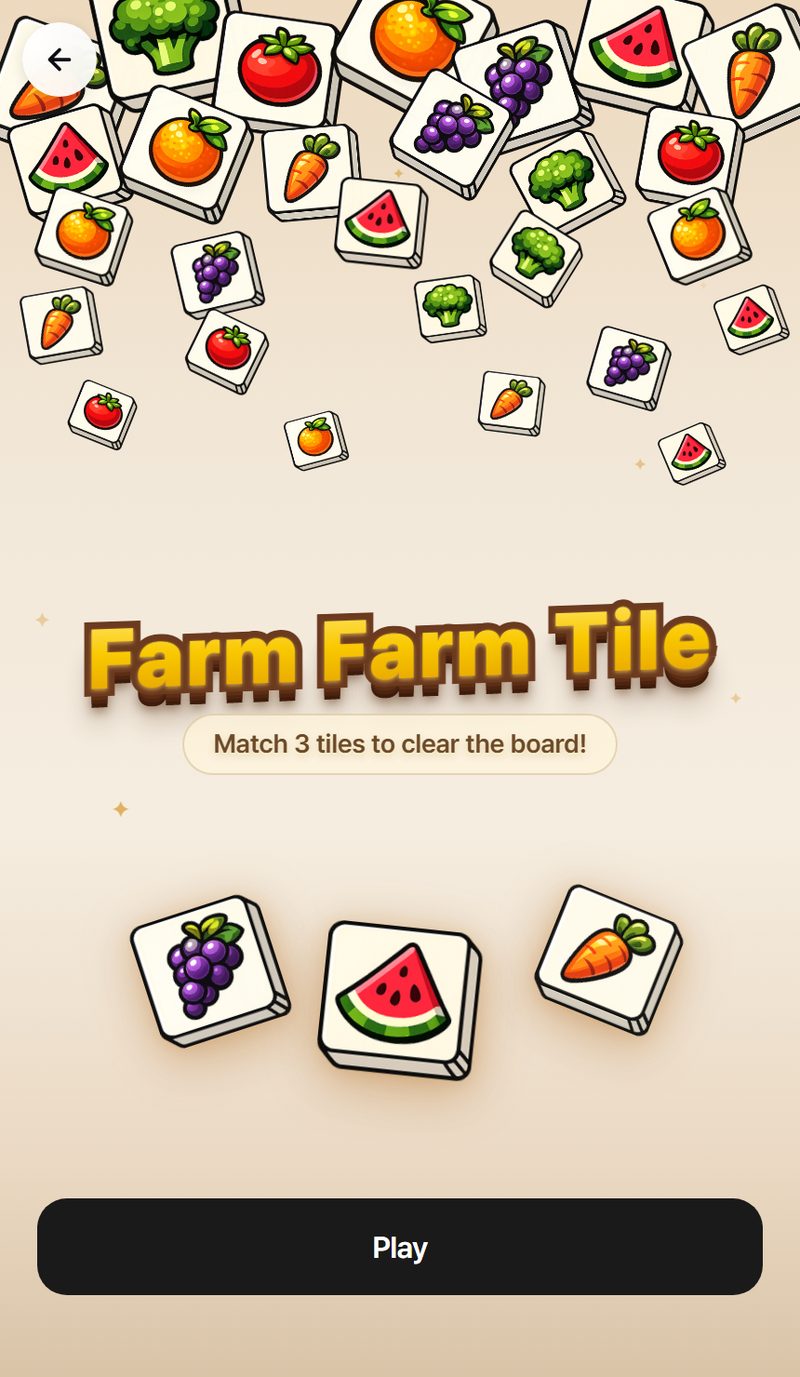
If you've never played: you tap tiles off a stacked board into a small tray, three of a kind clear, and you lose if the tray fills before you can make a match. Four seconds to learn. And that simplicity is exactly what makes the tuning a minefield — when the rules are this bare, every number you choose is felt.
The slot tray is the real difficulty knob
Everything in this genre flows from one cruel little constraint: how many tiles can you hold before you're forced to commit. That's it. That's the whole tension. Our tray has 7 slots — but you start with only 6 active. The seventh unlocks through an optional ad.
export const SLOT_COUNT = 7;
export const BASE_SLOT_COUNT = 6; // 기본 슬롯 수 (광고 확장 전)
One slot. Doesn't sound like much. It's enormous. With six slots you can hold two incomplete triples — two pairs — and then you're full, with nowhere to put a thing. The seventh slot is a parking space: the room to chase a third color while you wait on a match instead of being shoved into a panic dump. We tuned all twenty stages against the six-slot baseline, so the game is fully beatable without ever watching the ad. The seventh slot is relief, not a tollgate. We were very deliberate about that line.
Overlap: the rule that decides what you can even tap
A tile you can't reach is harder than a tile you can — obviously — and in Farm Farm Tile a tile is blocked the moment something on a higher layer sits on top of it. But "on top of" needs a number, and that number is one of the most important feel decisions in the game: a higher tile blocks a lower one only if it covers at least 30% of its area.
return overlap >= tileArea * 0.3; // 30% overlap threshold feels better in playWe landed on 30% the only way you can land on a number like this — by feel, over and over. Set it lower and tiles that look obviously tappable get locked anyway, and the game feels broken, like it's lying to your eyes. Set it higher and tiles buried under a clear overlap stay clickable, and it feels loose and sloppy. Thirty percent is the line where "is this one blocked?" matches what your eye already decided. Pair it with the deliberate 10% tile-to-tile overlap we use for shadow coverage, and the stacks read as real physical piles instead of a flat spreadsheet of crops.
The curve: tiles, layers, and tile types
Here's the actual shape of the climb. Stage 1 is hand-placed — a 35-tile butterfly using just three crops (carrot, broccoli, tomato) across 3 layers, a deliberate no-pressure handshake. From Stage 2 on, the layouts go procedural and three numbers ramp together.
| Stage 1 | Stage 2 | Stage 5 | Stage 10 | Stage 15 | Stage 20 | |
|---|---|---|---|---|---|---|
| Total tiles | 35 | 84 | 120 | 150 | 180 | 210 |
| Layers (max) | 3 | 5 | 8 | 10 | 12 | 14 |
| Tile types | 3 | 13 | 13 | 13 | 13 | 13 |
Look at what moves and what refuses to. Tile count and layer depth climb steadily — more to clear, more of it buried. But tile variety does something violent: it jumps from 3 to 13 between Stage 1 and Stage 2, and then it stops dead and holds at 13 for the rest of the game.
That's the most important decision on the whole table. Going from 3 colors to 13 is the single biggest spike in mental load in the entire game — one stage ago you tracked three "do I have a pair yet?" threads, and now you're juggling thirteen. We front-load that whole leap into one step so Stage 1 can stay a pure, gentle tutorial, and then we never touch variety again. Later stages get harder through depth and density, not by piling on more colors. Thirteen types against a six-slot tray is already brushing the edge of fair. Push it to fifteen and stages stop being "hard" and start being "lucky," which is the worst word in difficulty design.
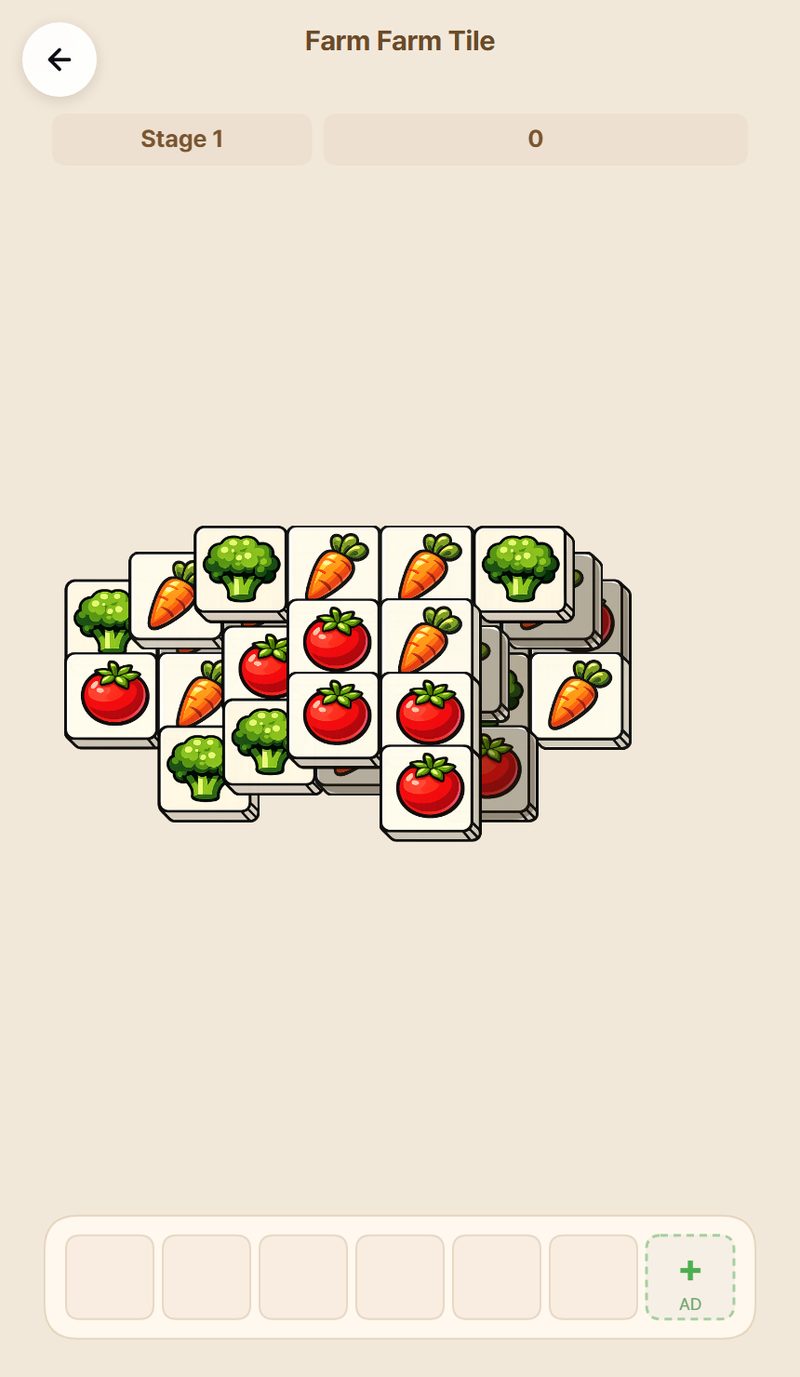
Layer count is the slow burn underneath all of it. Deeper stacks mean more tiles are blocked at any given moment, so your real choices — the tiles you can actually tap right now — stay scarce even as the board balloons. By Stage 20, fourteen layers across four clusters means most of the board is buried, and the game becomes a constant excavation: peel a tile, expose what's under it, hunt for the one that completes a triple.
Scoring rewards the squeeze
The scoring does something quiet and a little sneaky — it nudges you toward tighter, riskier play. A clear is worth more if it's part of a combo, meaning consecutive matches with no wasted tap in between.
export function calcScore(combo: number): number {
  if (combo <= 1) return 100;
  if (combo === 2) return 150;
  return 200;
}
So a lone match is 100, a second clear back-to-back is 150, and a third-and-beyond combo is 200 apiece. That gap — 100 for a safe shuffle, 200 for a chain you set up on purpose — is the whole difference between "I cleared the board" and "I cleared it well." It's a three-line table. It's also the difference between a player who survives a stage and a player who replays it for a better run, and the second one is the player you actually want.
What we were really tuning
Step back and the curve was never about making stages "harder" in the abstract. It's about holding the ratio between pressure — the filling tray, the deep stacks — and relief — the matches you can see coming together — inside one narrow, satisfying band, and holding it there for twenty stages without a single cliff. Too much pressure and it's stressful and people quit. Too little and it's boring and people quit. The window is small.
You can only thread a window that small when you can read every threshold in your own source and turn the exact dial you mean to turn. We built Farm Farm Tile ourselves, which is why we can tell you it's 30% overlap, 6 base slots, and a 35-to-210-tile climb — and why we could move each of those independently until the whole thing felt like one smooth hill instead of a staircase with one missing step. Go find the seams yourself: Farm Farm Tile.