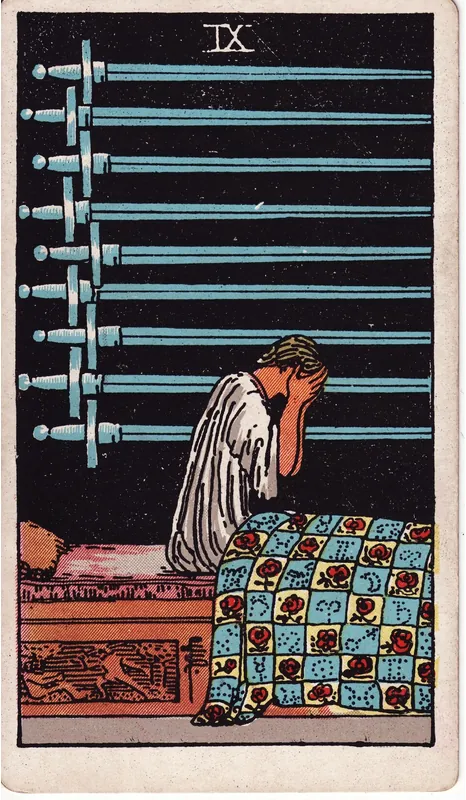
On the Rider-Waite-Smith card, a person sits up in bed in the dark, face buried in both hands, woken by worry. Nine swords hang on the wall behind them, lined up in a row, but not one of them is touching the figure. A carved panel on the bed shows two people in a duel. The scene is the middle of a sleepless night, the mind churning while the body sits helpless in the dark.
That's the Nine of Swords, and it's one of the most misunderstood cards in the deck. In the suit of Air, it's the card of anxiety and worry, the three-in-the-morning dread that feels enormous in the dark. Crucially, it doesn't picture a disaster happening; it pictures the fear of one. The swords are on the wall, not in the sleeper. When it appears, it's naming a state of mind, not foretelling a catastrophe.
Nine of Swords symbolism
The single most telling detail is spatial: the nine swords float on the wall, in the background, never once touching the figure. That gap between the blades and the body carries the whole idea. The threat is present in the room but not in the flesh, which is how anxiety tends to work, vivid and close and yet not the wound it imitates.
The rest of the card fills in the mood. The figure sits bolt upright with their face in their hands, the posture of someone jolted awake rather than resting, against a background of solid black, the total dark in which worries grow loudest. Look closer and small comforts remain: the bedspread is stitched with red roses and astrological signs, and the carved panel on the bed frame shows two figures in a duel, one standing over the other. The quilt suggests beauty and order haven't vanished; the carving hints that the "battle" tormenting the sleeper may be an old one, replayed in the mind long after it ended. The suffering is real, but the picture frames it as something happening in the head, in the dark, rather than in the world outside the bed.
At a glance
The core facts on the Nine of Swords are below, then unpacked in the sections that follow. This card shows the fear of something, not the thing itself; the swords hang on the wall and never touch the figure, and the dread it pictures is often larger than what's real.
- Arcana
- Minor Arcana
- Suit
- Swords
- Number
- 9
- Element
- Air
- Upright
- anxiety, worry, sleepless nights, fear
- Reversed
- releasing worry, recovery, facing the fear, lingering dread
Worry is clouding the picture, so as a straight answer it leans no.
Nine of Swords upright meaning
Upright, the Nine of Swords is anxiety made visible: sleepless nights, spiraling thoughts, guilt, and the particular way worry inflates when the lights are off. It captures the mind at its most catastrophic, rehearsing every bad outcome. The suffering is real, and the card takes it seriously. What it also points to is the source in the image: this is pain pictured as coming from inside, from thought, rather than delivered by an event outside the bed.
That distinction is where the card offers a way to hold the worry. Because the swords aren't piercing anyone, the card invites you to ask whether the dread has outgrown what's actually likely. Fears kept in the dark tend to grow; fears named in daylight often look smaller. The counsel is to name what's frightening you, say it aloud, write it down, or tell someone, and see whether the plain size of it matches the monstrous version the mind built at 3 a.m. If the worry is heavy enough to affect your daily life, this is a card that quietly supports reaching out to someone who can help.
Nine of Swords reversed meaning
Reversed, the Nine of Swords is often taken as the turn after the worst of the night, worry beginning to loosen its grip, a fear faced rather than circled, or the reach for help and relief. Read this way, it points toward the mind quieting rather than the dread deepening.
That reading isn't the only one, and it's worth keeping the traditional sense in view too. In the older Rider-Waite-Smith line, the reversed Nine can carry doubt, suspicion, shame, or worry that's been buried and denied rather than dealt with. So the reversal is less a promise of relief than a question: is the calm you feel genuine, or is the fear simply out of sight for now?
The card's tone also shifts with its neighbors. Drawn beside the Ten of Swords, the Nine's dread of an ending stands against an ending that has actually landed, which many readers find oddly steadying; beside the Moon, the worry can look fed by things still unclear, a fear built on half-seen shapes. Either way, the reversed card tends to ask you to look at the fear directly rather than telling you how it turns out.
Love, career & money
In love, upright the Nine of Swords can point to anxiety about a relationship, jealousy, insomnia over a conflict, or worry that feels larger than the situation. It invites you to voice the fear rather than rehearse it alone. Reversed, it can mean the worry is easing, or it can mean unspoken dread that still needs airing; either way it asks whether the fear matches what's actually there.
In career, this card often reflects work stress that's become overwhelming, dread of a review, losing sleep over a project, or fear of a loss that hasn't happened. The card's counsel is to name the specific fear rather than let it stay a shapeless weight. Reversed, it can point toward pressure easing and perspective returning, whether because support turns up or simply because the fear has finally been looked at squarely.
Around money, upright the Nine of Swords can reflect financial anxiety that outruns the actual numbers, and it asks you to look at them in daylight rather than at night. Reversed, it invites you to check the real figures against the imagined ones and see whether the fear has run ahead of them; any real financial decision belongs with a qualified professional. This is reflection for entertainment, not financial advice.
Nine of Swords FAQ
Does the Nine of Swords predict something terrible will happen?
No. This is one of the most misread cards in the deck. It doesn't depict an outer disaster; it depicts the fear of one. The figure sits up in bed with worries, not with an actual catastrophe. The card is about anxiety, the mind at three in the morning, and its usual message is a question worth sitting with: is the dread bigger than what's actually likely?
How should I read the Nine of Swords when I pull it?
Read it as a mirror for your worry, not a prediction. It names the anxious, sleepless state you may be in and gently notes that the mind tends to exaggerate in the dark. The swords hang on the wall, not in the person. The card's counsel is to bring the fears into daylight, name them, and share them with someone who can help you weigh them.
What does the Nine of Swords reversed mean?
Interpretations split here, so it's worth naming both. The older Rider-Waite-Smith tradition reads the reversal as doubt, suspicion, shame, or worry that's still buried rather than cleared. Many modern readers take it more hopefully, as anxiety beginning to loosen, a fear finally faced, or the reach for help. Rather than fixing one meaning, the reversed card asks whether the quiet you feel is genuine relief or the fear simply pushed out of sight.
What does the Nine of Swords reversed mean in love?
In a relationship it often turns on the gap between worry and reality. It can read as anxiety over a partner starting to ease, or as the moment you say a fear aloud instead of rehearsing it alone. In its harder, more traditional sense it can point to suspicion or unspoken dread that hasn't been aired. The card raises the question of whether the fear matches the situation, rather than settling it for you.
Pull a free 3-card tarot reading to see how Nine of Swords speaks to your own question, then explore related cards: Eight of Swords, Ten of Swords and The Moon.
All 14 Swords cards
-
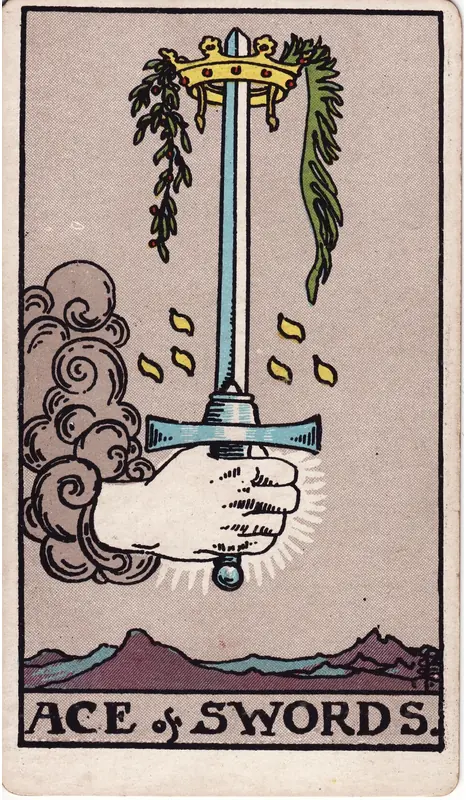 Ace of Swords
A
Ace of Swords
A
-
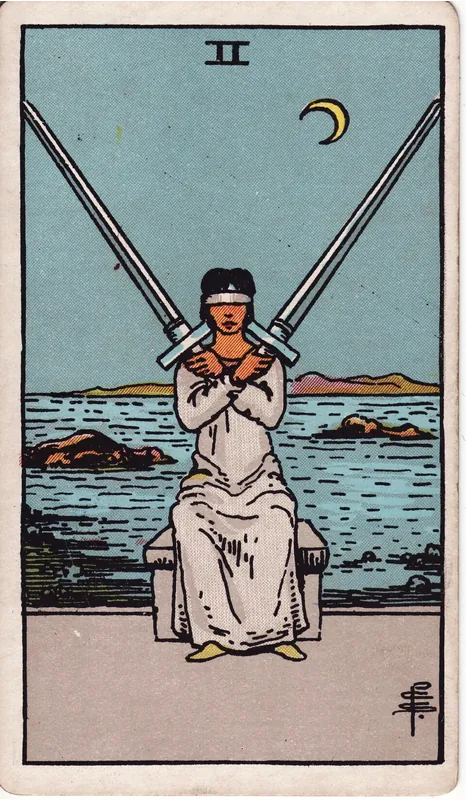 Two of Swords
2
Two of Swords
2
-
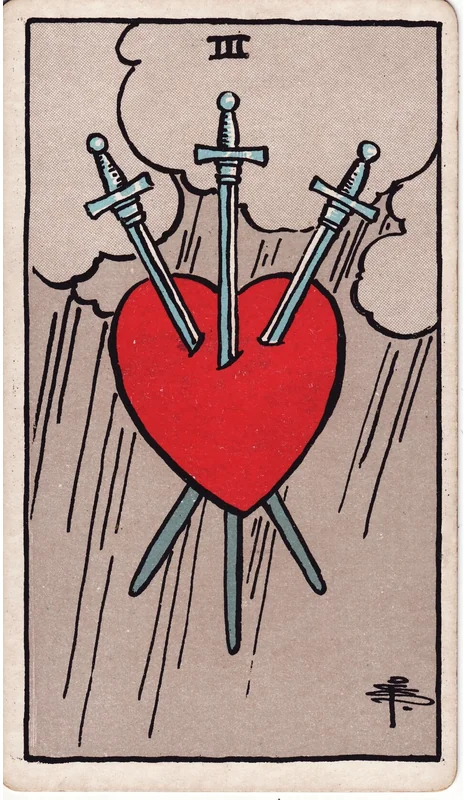 Three of Swords
3
Three of Swords
3
-
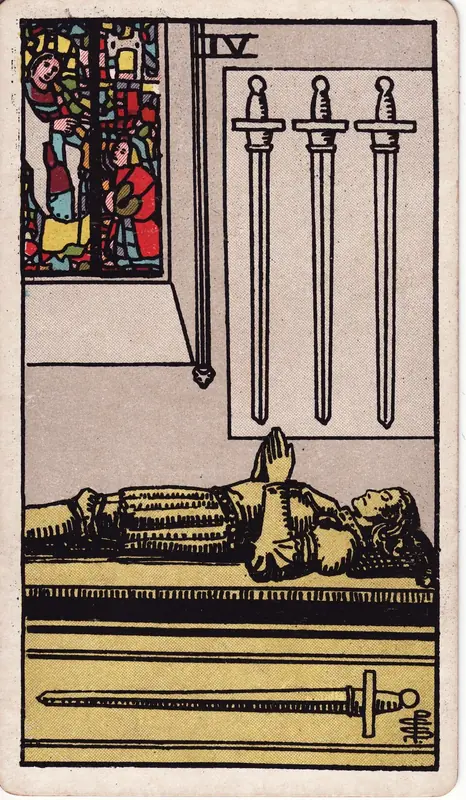 Four of Swords
4
Four of Swords
4
-
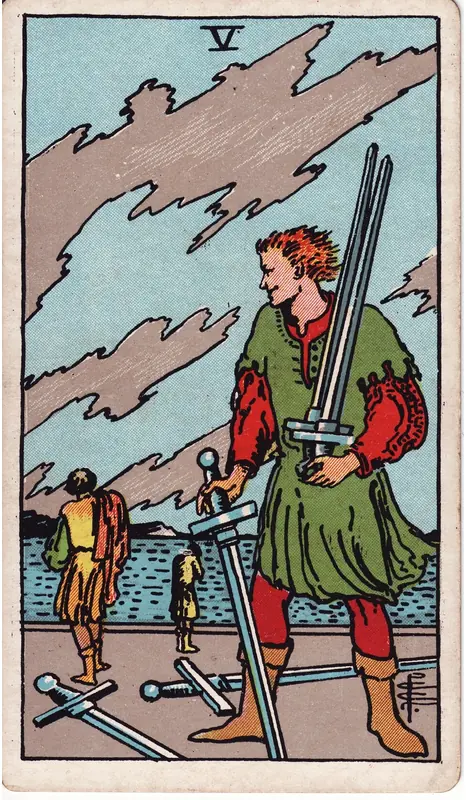 Five of Swords
5
Five of Swords
5
-
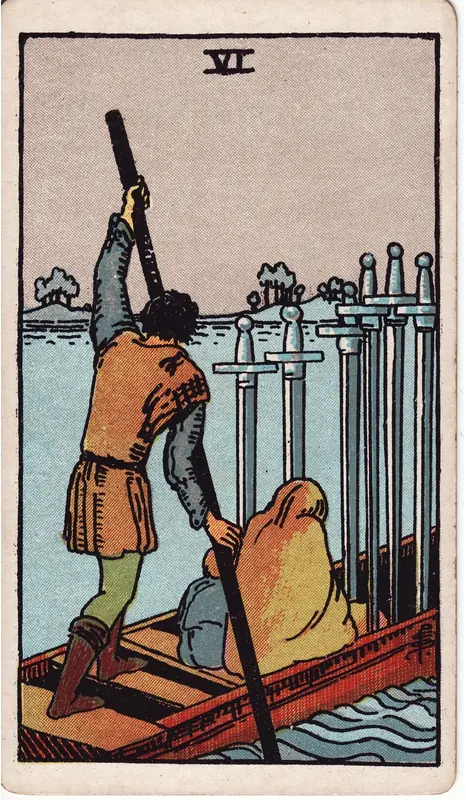 Six of Swords
6
Six of Swords
6
-
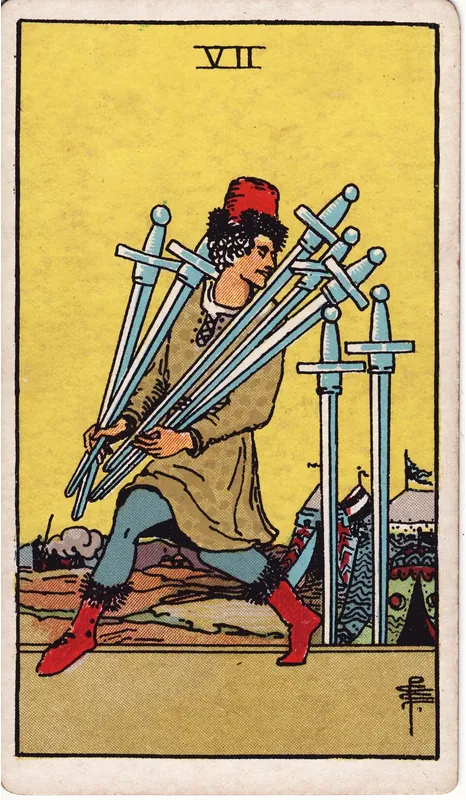 Seven of Swords
7
Seven of Swords
7
-
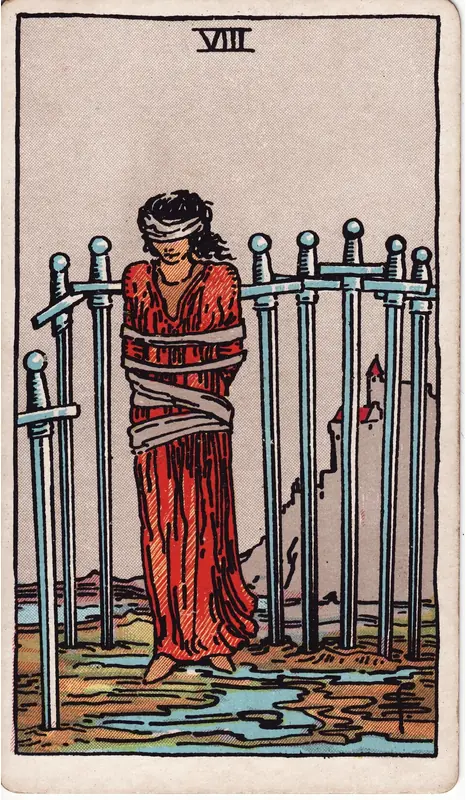 Eight of Swords
8
Eight of Swords
8
-
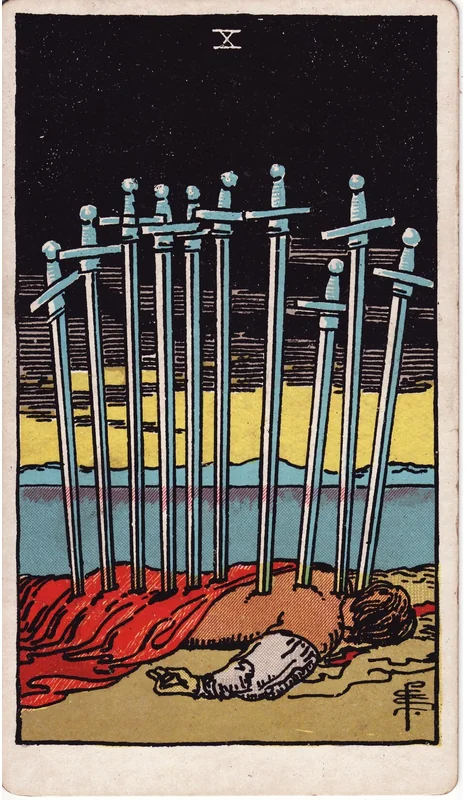 Ten of Swords
10
Ten of Swords
10
-
 Page of Swords
Pg
Page of Swords
Pg
-
 Knight of Swords
Kn
Knight of Swords
Kn
-
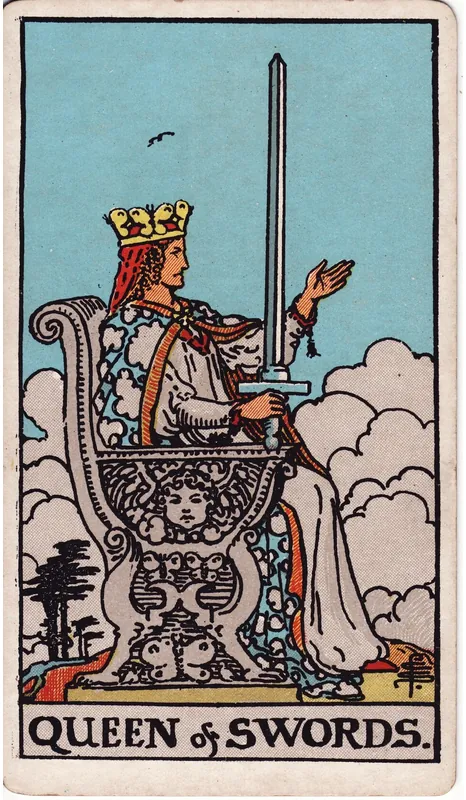 Queen of Swords
Qn
Queen of Swords
Qn
-
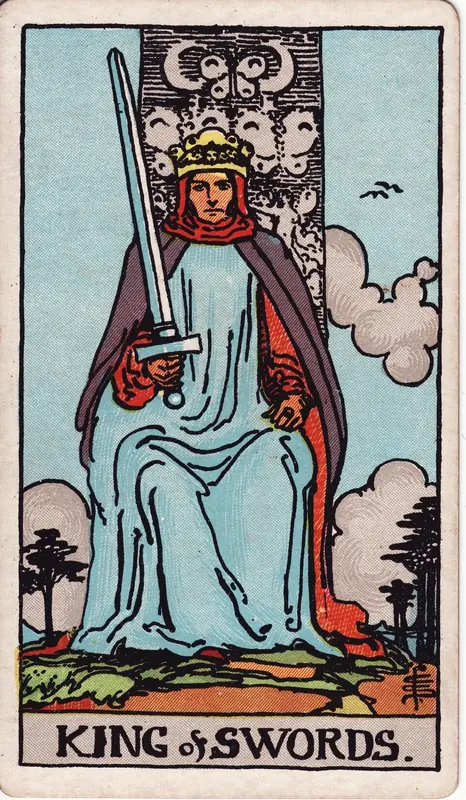 King of Swords
Kg
King of Swords
Kg
Looking for another suit? Browse all 78 tarot card meanings.
For entertainment purposes only. Tarot readings are not a substitute for professional medical, financial, legal, or psychological advice.