
- Genre
- Roguelike Defense
- Play time
- 5-15 minutes per run
- Best for
- One-more-run sessions
- Platform
- Mobile web, no install
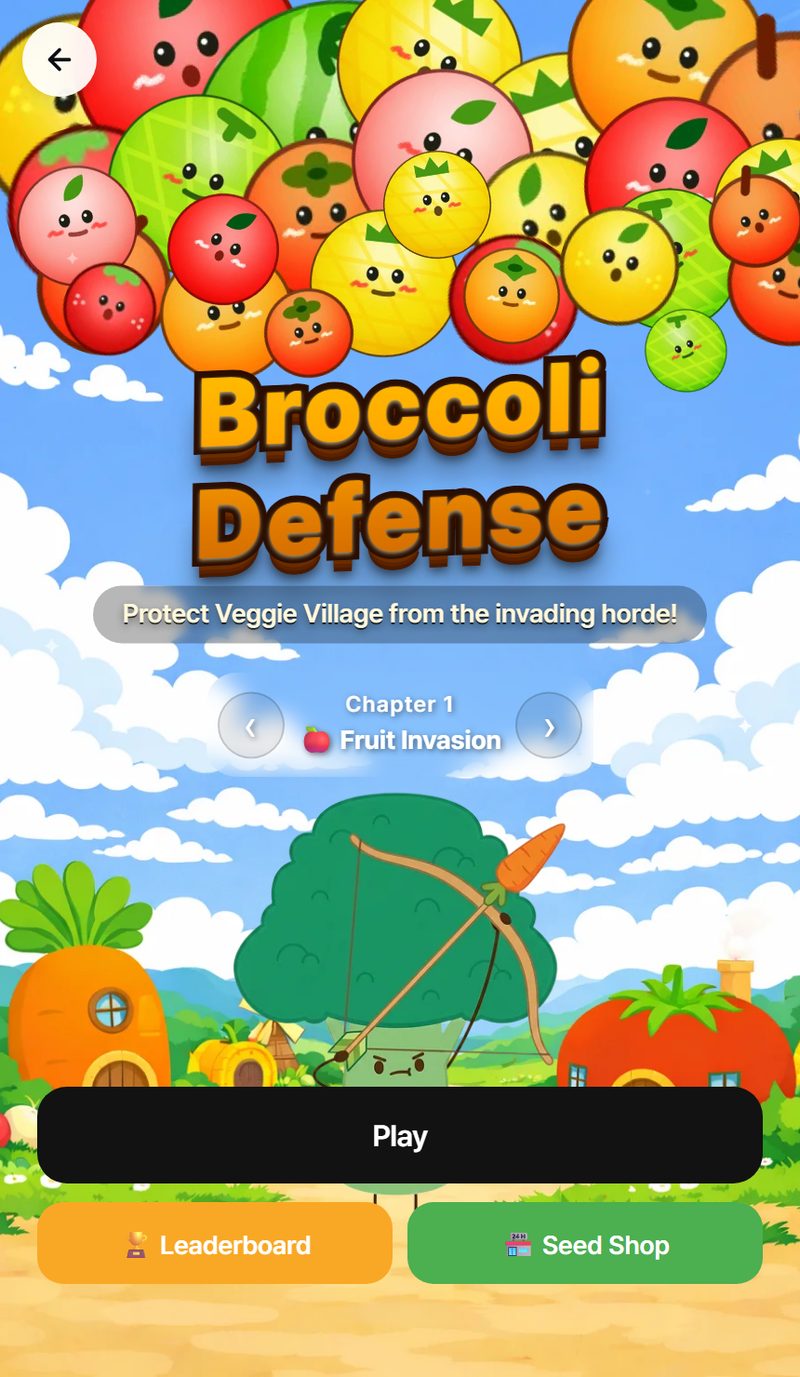
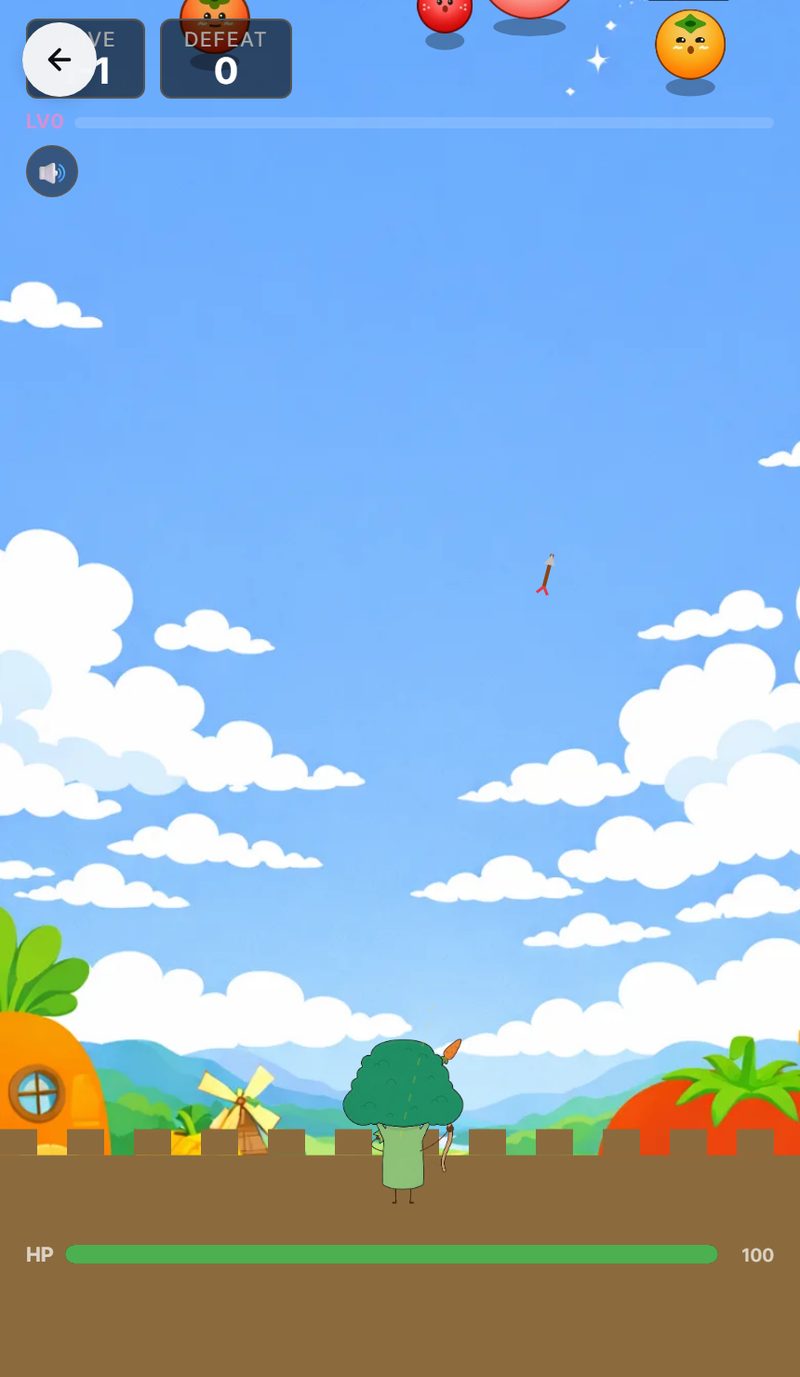
About
A small broccoli stands alone at the edge of the village. The fruit army is coming, and frankly, it has every advantage. You're slower. You have less health. Your starting kit is, generously, modest. Good luck.
Broccoli Defense is a single-character roguelike built around a simple, stubborn promise: you will die, and the next run will be easier because of it. Waves of apples, oranges, and worse roll in from the edge of the screen. You hold your ground, dodge what you can, and pick off enemies between breaths. Clear a wave and three skill cards appear — pick one of twelve possible upgrades and shape the run on the fly. Stack the right combination and a fragile broccoli turns into something the fruit army genuinely doesn't want to fight.
Boss waves break the rhythm in the best way. They hit harder, move differently, and force you to use the build you've drafted, not the one you wanted. When you fall (and you will), you carry meta-currency back to the village and spend it on permanent upgrades that follow you into every future run. Failure isn't punishment here — it's the loop.
The game is aimed squarely at players who enjoy Vampire Survivors, Soul Knight, and the broader survivors-like family. The hero stays charmingly stick-figure-simple while the monsters arrive in full 2D color, a contrast that leans into the underdog comedy. It's quick to learn, easy to restart, and built around the satisfying moment when a run you almost quit suddenly clicks.
What keeps Broccoli Defense interesting past the first few attempts is the way every run reshuffles your options. Because skill cards arrive three at a time and you can only take one, no two runs draft the same — a defensive build one game becomes an all-out glass cannon the next. The permanent upgrades you buy back in the village quietly raise your floor, so even an unlucky draft still feels like progress. The result is a loop that's forgiving enough to keep you going and deep enough to keep you experimenting, all in sessions short enough to fit between other things.
How to Play
- Move your broccoli around the field with a virtual joystick or drag input
- Auto-attack handles the basics — focus on positioning and avoiding incoming fruit
- After each wave, choose one of three skill cards to evolve your build
- Survive boss waves by adapting to new attack patterns instead of brute-forcing them
- When you fall, spend the currency you earned on permanent upgrades back at the village
Tips & Strategy
- Keep moving. Standing still is the fastest way to get surrounded. Treat the open field as your main defensive tool and lead enemies into long, looping paths.
- Commit to a build early. Spreading picks thinly across every card leaves you weak everywhere. Decide whether you're going offense or survivability by the second or third draft and stack toward it.
- Read the boss before you fight it. Spend the first seconds of a boss wave watching its movement and attack pattern. Reacting to a telegraph beats trading hits you didn't need to take.
- Spend meta-currency on your floor, not your ceiling. Early on, permanent upgrades to health and survivability pay off more often than flashy damage, because they help you reach the runs where damage matters.
- Treat a wipe as data. Every loss tells you which wave broke your build. Adjust your next draft around that weak point instead of repeating the same plan.
Controls and the Core Loop
You move your fighter around an open field with a drag or virtual joystick; attacks fire automatically, so your hands are free to do the one thing that matters — positioning. Enemies pour in from the edges, and your whole job is to stay alive while your auto-fire chips them down.
The clever part is how upgrades arrive. You don't level up on a fixed timer — you level up by killing enemies. The first few card picks come fast (after just 4 kills, then 6), and the threshold climbs as the run goes on (8, 11, 14, 18, 22, and onward, capping around 50 kills per level deep into a run). Each level pauses the action and offers you three skill cards; you take one and keep going. That's the roguelike spine: the build is assembled live, one forced choice at a time.
Skills, Rarity, and Evolutions
There's a deep pool of skills here — well over two dozen — sorted into common, rare, epic, and legendary rarities, each stacking several times for a compounding effect. They span offense (rapid fire, multi-shot, pierce, critical, explosive arrows, chain lightning, frost arrows, meteor), control and defense (shield, slow field, tornado, heal, vampiric lifesteal, berserker, time warp), and summonable vegetable allies (carrot, onion, corn, potato, pumpkin, chili) that fight beside you.
New skills don't all appear at once — they unlock as your best wave climbs. Wave 5 adds pierce and frost arrows; wave 10 adds critical and arrow rain; wave 15 brings explosive arrows; and the heaviest hitters (doom arrow, time warp, meteor) only show up once you've pushed past waves 25 and 30. So the longer you survive across runs, the richer your future drafts become.
The real depth is the evolution system. Max out two specific skills and a fused legendary card appears: fire coat + explosive arrow becomes Inferno Storm; frost arrow + arrow rain becomes Blizzard; pierce + multi-shot becomes Storm Pierce, and several more. Building toward an evolution, rather than spreading picks thin, is what separates a run that fizzles from one that snowballs.
Waves, Bosses, and Difficulty
Waves 1 through 10 follow a hand-tuned curve: a 12-enemy tutorial opener, the first elite (a beefier enemy with triple health) showing up around wave 4-5, and a real mid-game pressure spike around waves 6-7 as enemy counts and speed climb. Wave 10 is the first boss — a hugely durable foe with a glow and roughly twenty times normal health (the watermelon, in the fruit chapter).
Past wave 10 the game goes infinite, with bosses returning at waves 20, 30, 40 and beyond (durian, then pineapple, then coconut), each far tankier than the last. The infinite stretch also throws special waves at you: Scout Rushes (swarms of fast, fragile enemies), Elite Rushes, and generous Blessing waves that dial enemies back and pour out extra seed currency.
Three difficulty settings — Normal, Hard, Expert — multiply enemy health, speed, and elite counts (Expert pushes health to 1.75x and adds four extra elites per wave), and clearing the fruit chapter unlocks a tougher cookie-themed chapter on top.
Build Strategy
- Pick a direction by your third card. With three random cards each level, it's tempting to grab one of everything. Don't. Decide early whether you're a glass-cannon (multi-shot, pierce, critical) or a survivor (shield, slow field, heal, allies) and stack toward it.
- Chase an evolution on purpose. Evolved legendaries are run-defining. If you've already got fire coat, prioritize explosive arrow so Inferno Storm comes online — a planned fusion beats two half-built skills.
- Keep moving; the field is your shield. Auto-attack handles damage, so your job is to never get surrounded. Lead packs in long, looping arcs and let your fire mow them down as they chase.
- Spend Blessing waves wisely. When a Blessing wave hands you 2.5x or 3x seed drops, it's the time to farm — seeds fund permanent upgrades back at the village that raise the floor of every future run.
- Read bosses before trading hits. Spend a boss's opening seconds watching its movement and pattern. With twenty-times-normal health, you can't brute-force it — you out-position it.
- Push your best wave to unlock more. Because the skill pool expands with how deep you've gone, even a losing run that sets a new wave record makes your next draft stronger. Reaching for one more wave is genuine long-term progress.
Frequently Asked Questions
Do I aim and shoot manually?
No — attacks fire on their own. You control movement only. That's deliberate: the skill is in dodging and positioning, not clicking targets, which keeps the screen readable when dozens of enemies are on it.
How do I level up and get new skills?
By killing enemies, not by a timer. Hit the kill threshold for your current level and the game pauses to offer three skill cards. The threshold starts at 4 kills and grows as you go deeper into a run.
What are evolutions?
Max out two specific skills and they fuse into a single legendary skill — for example, frost arrow plus arrow rain becomes Blizzard. There are nine such recipes, and building toward one is the strongest way to power-spike a run.
What carries over between runs?
Seed currency funds permanent upgrades in the village, and your best-wave record permanently expands the skill pool that appears in future runs. Even a failed run leaves you stronger for the next one.
How often do bosses appear?
The first is at wave 10, then again at waves 20, 30, 40 and onward, each tougher than the last. They have a distinct glow and roughly twenty times a normal enemy's health, so they force you to use the build you've actually drafted.