You played that hand perfectly. You held your aces, cycled the stock with the patience of a saint — and you still lost. Before you blame yourself: there's a decent chance it wasn't your fault. Some Klondike deals are dead on arrival, unwinnable from the moment the cards hit the table. The only question is how many.
So we counted.
Short answer: Not every deal can be won. In our own testing, at least 70% of random Klondike deals are winnable — about 70.1% in Draw 1 and 69.5% in Draw 3. Treat that 70% as a floor, not a verdict: the true number probably lands between 70% and 82%. And "winnable" isn't the same as "won" — the share an average player actually wins is far lower, usually pegged around 33%. That gap between what's possible and what people pull off is the whole story.
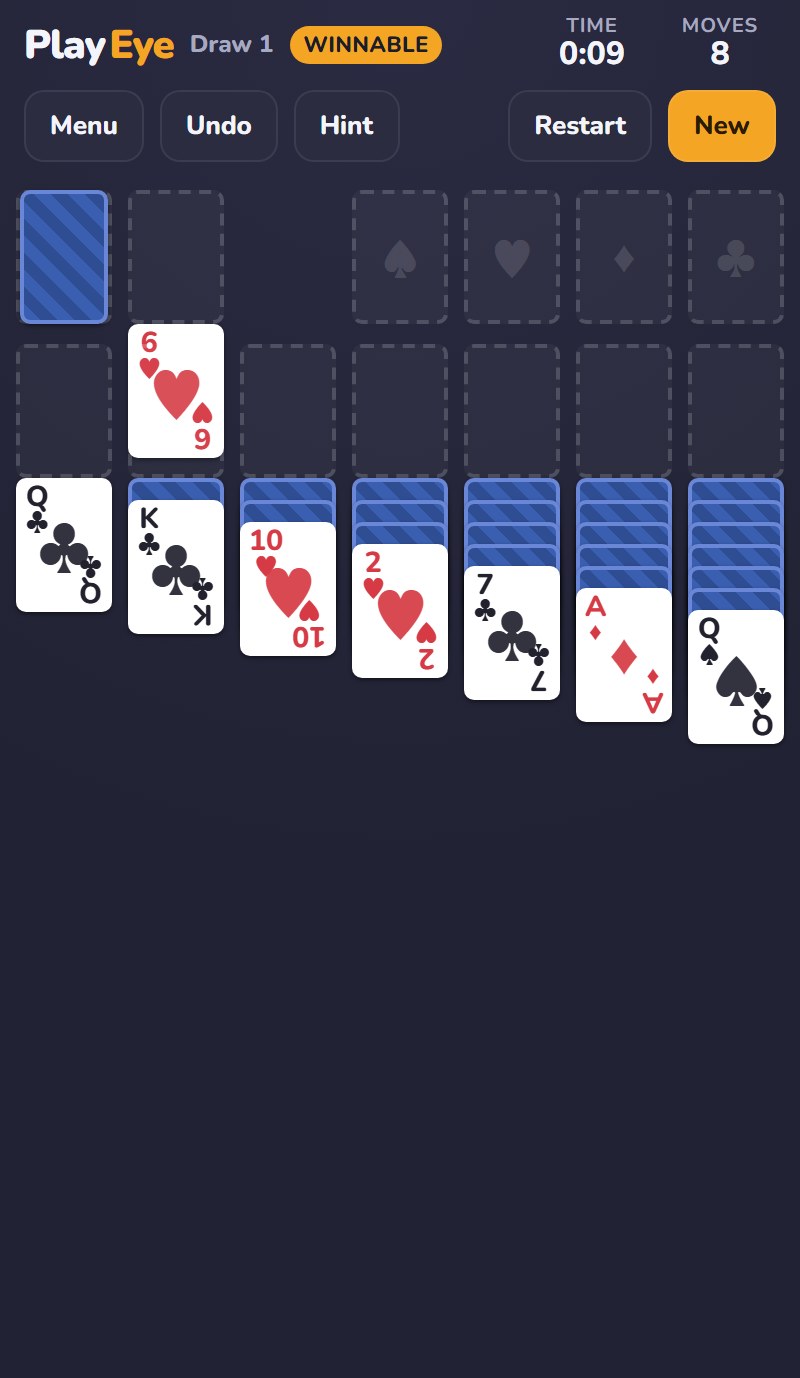
Most sites answer this by quoting a number off another site, which got it off another site. We didn't have to. We built a Solitaire that screens its own deals with a solver, so we measured winnability for real — across 1,530 random shuffles. This isn't a number we read. It's one we earned at 2 a.m. with a laptop fan screaming.
First, what does "winnable" even mean?
You can't quote a percentage until you decide what you're counting, and there are two very different definitions out there — which is why the internet can't agree on a number.
The strict one is thoughtful (or full-information) solitaire. A deal is winnable if some sequence of legal moves clears it when you're allowed to see every card — including the ones lying face-down, taunting you. Picture a player with X-ray vision who reads the buried tableau and the whole stock order. If even they can't win it, the deal is genuinely impossible. No human, no genius, no amount of "just one more try" was ever going to crack it. The deck was rigged from the shuffle.
That's the number we measured. It answers "could this be won by perfect play?" — not "will you win it?" Mix those up and you'll quote wildly different figures, which is exactly what everyone does.
How we measured it: a Friday night and a solver that doesn't sleep
We wrote a thoughtful Klondike solver — a program that takes a fully dealt board, stares at all 52 cards at once, and hunts for any line that wins. Then we pointed it at random shuffles, let it run, and went to bed. By morning, 1,530 deals had a verdict, and 463 of them couldn't be cracked inside the time we gave it. Two rules ran the whole thing:
- Five seconds. That's all we gave it. If the solver can't find a win in that window, it records the deal as not proven and moves on. No mercy, no overtime.
- It never bluffs. On a timeout, the solver says "not solvable" — it does not guess. So a slow-but-actually-winnable deal gets counted as a miss. It would rather undersell a win than fake one.
That second rule is the difference between a number you can trust and one that just sounds good. We'll circle back.
The results
Here's what the solver could prove across 1,530 deals:
| Mode | Deals tried | Proven winnable | Win rate | Avg. search effort |
|---|---|---|---|---|
| Draw 1 | 668 | 468 | 70.1% | ~74,000 nodes/deal |
| Draw 3 | 862 | 599 | 69.5% | ~85,000 nodes/deal |
70.1% for Draw 1. So roughly three of every ten deals you started were never going to love you back — and that's the optimistic read.
69.5% for Draw 3. Almost identical to Draw 1, and if that surprises you, good — it surprised us too. Popular wisdom expects Draw 3 to be a bloodbath. Hold that thought.
~74,000 to 85,000 search positions per solved deal. Klondike's branching factor is monstrous; that node count is the toll you pay to be certain a winning line exists instead of just hoping one does. Every "yes" in that table cost tens of thousands of moves.
Why 70% is the floor, not the truth
Now the honest part — the one most sites skip. Our 70% is almost certainly an undercount, and the culprit is that five-second stopwatch. Remember the no-bluff rule: every deal that timed out got filed as a "miss," even the ones that were genuinely winnable and just needed longer. We threw those out on purpose, because the screen behind our live game would rather call a deal unwinnable than risk dealing you a board it can't beat. So our 70% is what we could prove in five seconds flat, not what's winnable given all the time in the world.
The most-cited academic estimate — Ronald Bjarnason and colleagues, working on thoughtful Klondike with no stopwatch — puts the real rate closer to around 82%. Ours sits below for the obvious reason: every brutal, slow-to-solve deal a patient infinite solver would eventually beat is one we timed out on and tossed. So the honest answer isn't a single number. It's a range:
The true percentage of winnable random Klondike deals sits somewhere between our measured floor of ~70% and the ~82% academic estimate. Ours is what we could prove fast; theirs is what's reachable with patience.
We'll take a floor we measured ourselves over a confident number we can't back up.
"Winnable" and "you actually win" are not the same thing
Here's the gut-punch. Even if ~82% of deals can be won, the share an average player actually wins is much lower — commonly cited around 33%, often worse depending on the player and ruleset.
Why the canyon between "82% winnable" and "33% won"? Two reasons, and neither is "you're bad at cards." First, you're playing blindfolded: that 70–82% assumes full sight of every card, but the buried tableau and stock order are hidden, so even a flawless player is guessing under fog — some winnable deals demand a line you can't know is correct from what's showing. Second, one early move can kill the game: promote a card to the foundation a beat too soon and you strand the exact card you needed three moves later. The deal was winnable. Past tense.
So when you lose, it's one of two things: the deal was in the unwinnable minority, or — far more often — it was winnable and the path was just hidden well. That distinction is why we built our Solitaire the way we did.
Draw 1 vs Draw 3: why our numbers are practically twins
Everyone "knows" Draw 3 is harder, and for how easily a human wins, that's true — pulling three at a time buries the card you wanted and forces you to count like an accountant at year-end.
But our solver measures something narrower: is a deal winnable at all under full information? There, the gap is almost nothing — 70.1% versus 69.5%, 0.6 percentage points. With every card in sight, cycling the stock three at a time barely changes whether a winning line exists; it mostly changes how hard that line is to find in play. So Draw 3 isn't more impossible. It's more frustrating. There's a difference, and now you can prove it.
What we do with this in our own game
Knowing the real winnable rate let us make a call most Solitaire apps don't bother with: we pre-screen the deals. Instead of shuffling blind and dealing you whatever falls out — unwinnable duds included — our Klondike Solitaire draws from a pool the solver already cleared: 1,067 verified deals (468 Draw 1, 599 Draw 3). The board in front of you is one we beat in under five seconds with every card face-up. So if you lose it, there was a way through — you just didn't spot it this time. That's a far better loss than a dead end someone handed you on purpose.
Want the full technical story — the solver guts, the no-false-positives rule, how we kept the offline test seeds identical to the live deal? We wrote that up separately in how we made every Solitaire deal winnable.
FAQ
Is every Solitaire game winnable?
No — anyone who says otherwise hasn't run the numbers. A real chunk of random Klondike deals are flat-out impossible, even with every card face-up. We could prove ~70% winnable inside a five-second budget; the true figure likely climbs toward ~82%, which still leaves roughly one in five or six deals genuinely unbeatable. That's why we screen deals in our game instead of crossing our fingers.
Does Draw 3 change the odds compared to Draw 1?
For winnability under perfect play — barely. Our data: 70.1% (Draw 1) versus 69.5% (Draw 3), basically a rounding error. For how often a human wins, Draw 3 is genuinely harder, because drawing three at a time hides the card you want. The deals are about equally winnable in principle; Draw 3 just buries the line deeper.
Why do I lose deals that are supposedly winnable?
Two reasons. One: "winnable" is measured with every card face-up, but you play with the stock and buried cards hidden — so the deal can hinge on a line you can't deduce from what's visible. Two: a single early slip, usually promoting a card to the foundation too soon, strands a card you needed later. A winnable deal guarantees a path exists. It doesn't guarantee you'll find it.
What win rate should I expect as a player?
Average human win rates are commonly cited around 33% for Klondike — well under the ~70–82% theoretical ceiling. Closing that gap is partly practice and partly knowing the deal was beatable in the first place, which is the entire point of playing on a screened pool: every loss is a puzzle you could have solved, not a trap you were dealt.