- Genre
- Card Game
- Play time
- 5-15 minutes per deal
- Best for
- The classic one-more-deal habit
- Platform
- Mobile web, no install
The Card Game That Came With Your Computer
Almost everyone has played Klondike Solitaire, even people who'd swear they don't play games. It's the patience game that shipped on hundreds of millions of desktops, the one you'd open "for a minute" and look up from twenty minutes later. The appeal hasn't changed: a full deck, four empty foundations to build up by suit, and a tableau that starts as a tangle and slowly resolves — or doesn't — into a clean win.
This is Klondike Solitaire free in your browser, no download and no account. You get both classic deal styles: Draw 1, where the stock turns over one card at a time, and the tougher Draw 3, where cards come three at a time and only the top one is playable. Beyond that, the tools are all about flow. Unlimited undo lets you walk back a bad move or experiment with a line without losing the game. A hint points out a legal play when you can't spot one. Auto-complete finishes a won position instantly so you don't have to click out a foredetermined ending. You can drag and drop a card or run of cards, or just tap one to send it to its best available spot. Move count and a timer track how efficient and how fast your win was.
Every Deal Is Winnable — If You Want It to Be
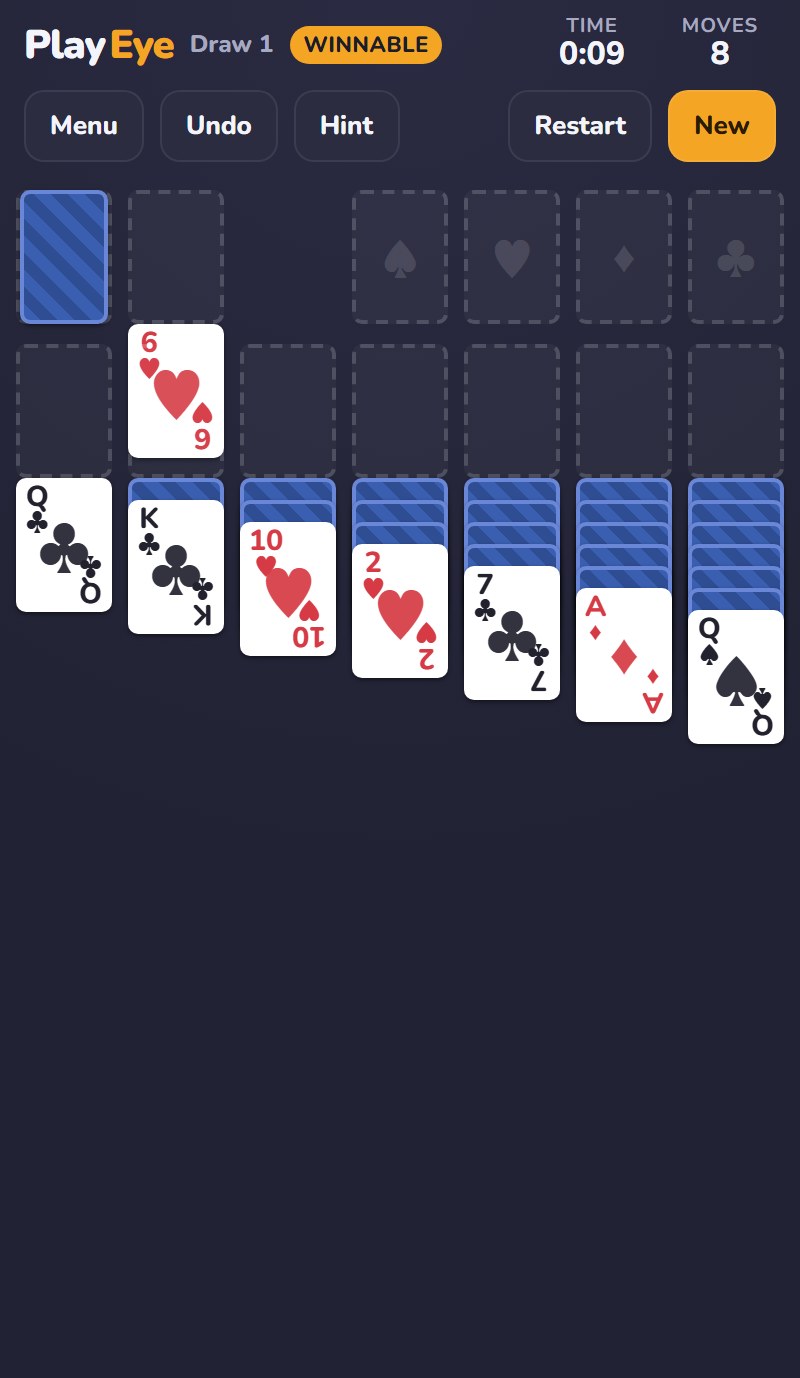
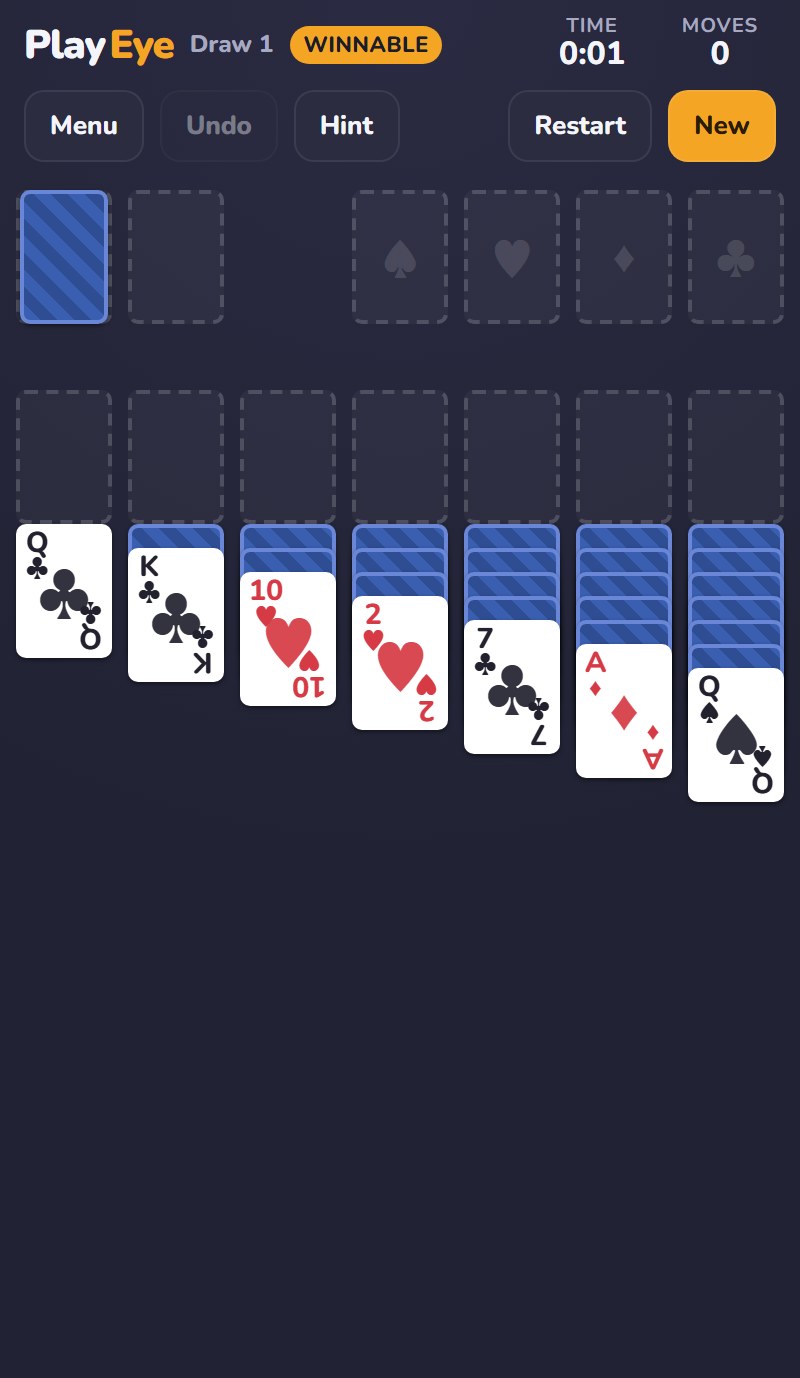
Roughly one in five random Klondike deals simply can't be won, no matter how perfectly you play. Grinding a board that was dead from the shuffle is the most frustrating part of classic solitaire. So this game ships with a Winnable deal mode turned on by default: every deal is guaranteed solvable. Behind the scenes, a Klondike solver plays each candidate deal to completion and only deals you ones it has proven can be won — verified separately for Draw 1 and Draw 3, because a deal that's winnable one-card-at-a-time isn't always winnable three-at-a-time. When you're in Winnable mode you'll see a small Winnable badge on the board, so you always know the win is on the table and the only thing between you and it is your own play. Prefer the old-fashioned coin flip? Switch to Random deal in the menu and take your chances with the shuffle, unsolvable hands and all. Your choice is remembered on this device.
How to Play
- The goal is to move all 52 cards onto the four foundations, each built up by suit from Ace to King.
- Seven tableau columns hold the main board. You build down them in alternating colors — a black six goes on a red seven, and so on.
- Only a King can move into a completely empty tableau column.
- Flip cards from the stock to the waste pile to bring more cards into play, drawing one or three at a time depending on the mode you chose.
- Move a single card or a properly ordered run between columns by dragging, or tap a card to auto-send it to a valid destination.
- Use Undo freely, ask for a Hint when stuck, and let Auto-complete wrap up once every card has a clear path home.
Strategy: Winning More of Your Deals
Klondike rewards planning over speed. A surprising number of games are lost not to bad luck but to moves made too early.
- Play your Aces and Twos, then slow down on the foundations. Getting low cards up early is almost always right. But sending mid and high cards to the foundation too soon strips the tableau of the cards you need to build sequences and uncover face-down rows. A card on the foundation can't help you anymore; a card in the tableau still works for you.
- Prioritize exposing face-down cards. Every flipped tableau card is new information and a new option. When you're choosing between two legal moves, take the one that turns over a hidden card. Columns with the most face-down cards are your biggest problems — chip at them first.
- Don't empty a column without a King ready. An empty column is powerful, but only a King can fill it. Clearing one with no King available to move in often just freezes part of your board. Plan the King move and the empty in the same breath.
- Work the stock deliberately, especially in Draw 3. In turn one, every card reaches the waste eventually, so the order is forgiving. In turn three, only every third card is immediately playable, so you have to track which buried cards you want and cycle the stock to surface them. The solitaire turn one vs turn three difference is mostly this: turn three asks you to remember and plan around the deck, while turn one lets you brute-force access to any stock card.
- Use unlimited undo as a planning tool, not just a rescue. Try a line of play, see where it dead-ends, and undo back to the fork. Because undo is free here, you can effectively read several moves ahead by playing them out and reversing.
- Hold a useful card in the waste when it helps. You don't have to play a waste card the instant it's legal. Sometimes leaving it there preserves a future option — like waiting for the matching color before committing a run.
- Think about color balance when building runs. Long alternating-color sequences are satisfying, but if you build a run that locks several needed cards under the wrong color, you can stall. Before extending a column, check that the cards you'll need next aren't getting buried.
- In Random mode, recognize an unwinnable deal early. Not every random Klondike game can be won, and stubbornly grinding a frozen board wastes time. If face-down cards stop flipping and the stock cycles with no new plays, it's often cleaner to redeal than to chase a dead position. (In Winnable mode this never happens — a solution always exists, so a stall means there's still a better line to find, not a dead board.)
A Short History of Patience
Solitaire — or "patience," as it's still called across much of Europe — refers to a whole family of single-player card games that took shape in late 18th and 19th century Europe, with early references appearing in northern Europe and the games spreading through France and Britain. Klondike is just one variant among hundreds, but it became the variant the world thinks of when someone says "solitaire."
The name Klondike ties the game to the Klondike Gold Rush of the 1890s in Canada's Yukon, and the popular story is that prospectors played it to pass long northern nights — though, as with a lot of card-game origins, the precise history is murky and hard to pin down with certainty.
What's not murky is how it became universal. In 1990, Microsoft bundled a digital Klondike with Windows 3.0, reportedly partly to teach a generation of new users how to drag and drop with a mouse. It worked far better than anyone planned. Solitaire became one of the most-played computer programs in history, a permanent fixture of office downtime, and the reason "solitaire" and "the card game on the computer" are nearly synonymous. Browser and mobile versions like this one carried it forward, keeping the same deal and rules while adding undo, hints, and auto-complete that the physical deck never offered.
Frequently Asked Questions
Is every solitaire game winnable?
It depends on the mode you pick. In classic random Klondike, no — around one in five deals can't be won no matter how well you play. That's why this game defaults to Winnable Deals mode, where every game is pre-verified as solvable by a solver before you ever see it, checked separately for Draw 1 and Draw 3. If you prefer the traditional gamble, switch to Random deal in the menu and take whatever the shuffle gives you.
Is Draw 1 or Draw 3 better for me?
Draw 1 is the more forgiving, higher-win-rate mode and a good place to learn. Draw 3 is the traditional challenge: fewer cards are immediately playable, so it demands more planning and a better memory for the stock. Many players treat Draw 3 as the "real" version.
Does undo count against my score?
Undo is unlimited and free to use here. It does affect your move count and time if you're chasing an efficient win, but there's no penalty that ends or invalidates the game — use it to experiment.
What does auto-complete actually do?
Once every remaining card has a guaranteed path to the foundations, auto-complete plays out that finish for you so you don't have to click through a result that's already decided. It only kicks in when the win is mathematically locked.
Can I move several cards at once?
Yes. A properly ordered, alternating-color run can be dragged as a unit onto a valid column, as long as the bottom card of the run fits the destination. This is essential for shuffling sequences around to free up the cards you need.