- Genre
- Logic Puzzle
- Play time
- 3-30 minutes per grid
- Best for
- Calm, focused brain training
- Platform
- Mobile web, no install
A Number Puzzle You Never Really Finish Learning
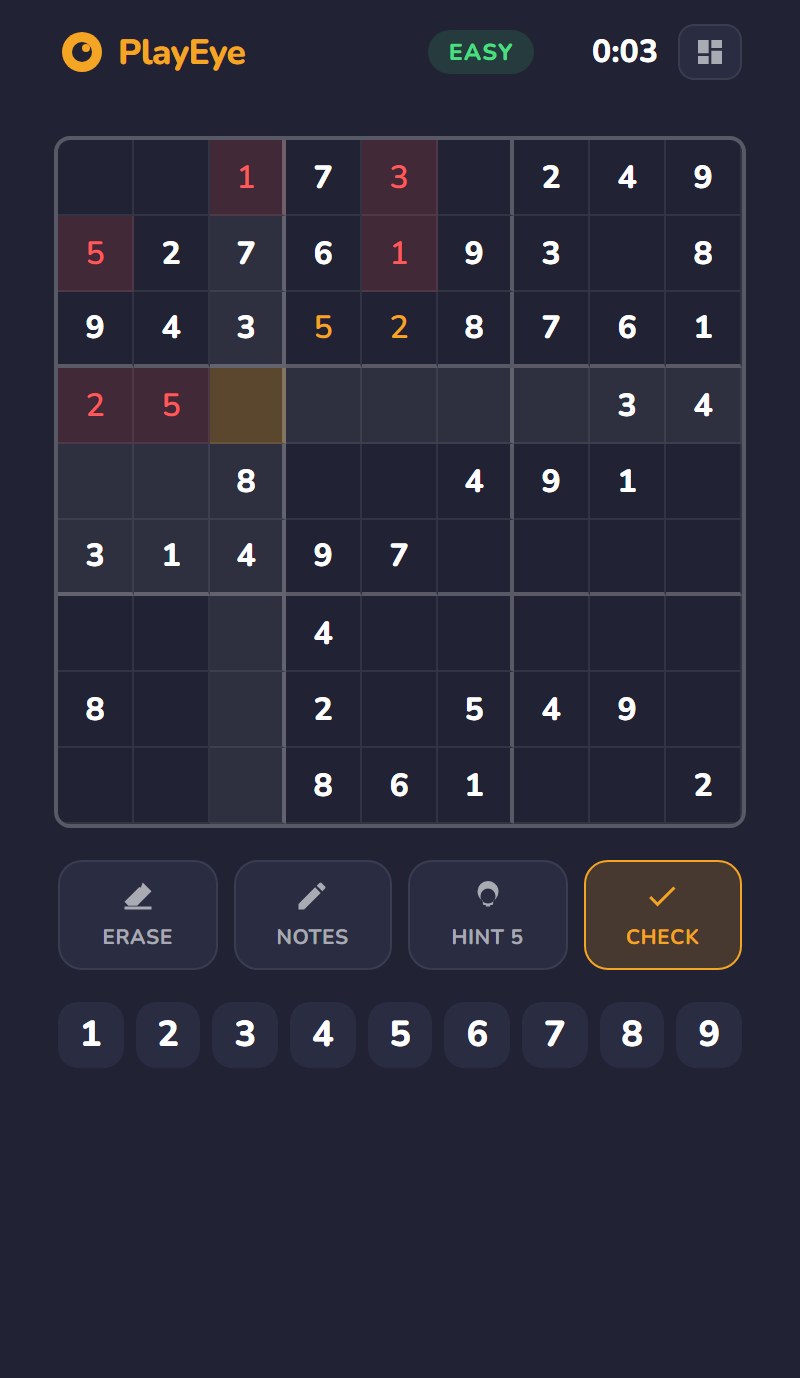
Sudoku is the rare puzzle that feels solved the moment you understand the rule — fill the grid so every row, column, and box holds one to nine — and then keeps you busy for years anyway. The rule is trivial. Finding the next correct number, especially once the easy fills run out, is where the whole game lives.
This version runs straight in your browser with nothing to install. You pick a difficulty, get a fresh grid, and start filling. Every puzzle here is generated with a guaranteed unique solution, so you'll never hit a dead end where two answers both look legal — if you're stuck, there's always a logical reason waiting to be found, never a guess to gamble on. Pencil marks let you jot candidate numbers into a cell's corners, a hint will surface the next safe placement when you're truly stuck, and an optional error check flags a wrong entry the moment you commit it. A timer tracks each run, and the game remembers your best time per difficulty, so a casual fill becomes a quiet race against yourself.
How to Play
- Tap an empty cell to select it, then tap a number from one to nine to place it.
- Every row, every column, and every 3×3 box must contain all nine digits with no repeats. That single rule decides every move.
- Toggle pencil-mark mode to drop small candidate numbers into a cell instead of a final answer — these are your notes, and they don't count as a solution.
- Hit Hint when you're stuck and the game reveals one correct number with the cell it belongs in.
- Turn on error checking if you want instant feedback; leave it off for a stricter, no-safety-net solve.
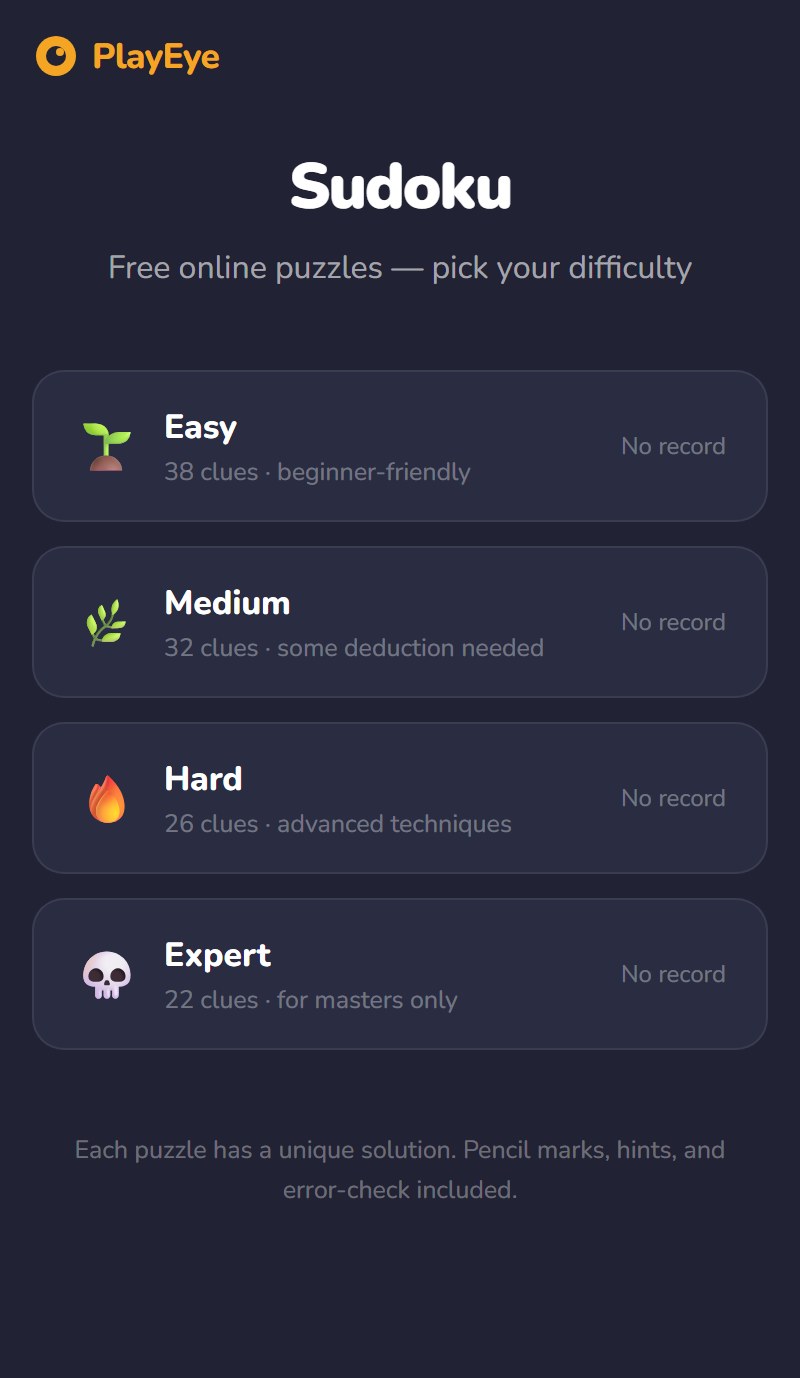
- Choose Easy, Medium, Hard, or Expert before you start. The grid size never changes — only how many numbers you're given and how much chained reasoning the solve demands.
Strategy: From First Fill to Expert Grids
The gap between an easy grid and an expert one isn't the rules — it's the techniques you reach for. Build them in roughly this order.
- Scan for the obvious singles first. Before anything clever, look for cells where only one number can possibly fit, and rows or boxes where a digit has exactly one open home. On easy and medium puzzles this clears most of the board on its own. This is the bread and butter of easy sudoku for beginners, and skipping it on harder grids just wastes time.
- Use pencil marks early, not late. Beginners often resist notes and try to hold candidates in their head. Don't. The moment scanning stops producing free fills, mark every empty cell with its possible digits. The hard puzzles are basically unsolvable without this layer written down.
- Hunt for "hidden singles." A cell might list three candidates, but if one of those digits can't go anywhere else in its row, column, or box, it belongs in that cell — even though the cell itself isn't down to one option. Beginners miss these constantly because they only look at cells with a single candidate.
- Learn the naked pair. When two cells in the same unit share the exact same two candidates and nothing else, those two digits are locked to those two cells. You can erase them from every other cell in that unit. This is the first technique that genuinely cracks hard sudoku puzzles open.
- Watch for pointing pairs and box-line reduction. If a candidate inside one box is confined to a single row or column, it must land somewhere on that line within the box — so you can clear that candidate from the rest of the line outside the box. It feels like a small win but it usually unlocks a chain of fills.
- Work the most-constrained cells, not the prettiest area. Your instinct is to fill where you've already made progress. The faster path is the cell or unit with the fewest open options, because that's where a forced move is most likely hiding.
- On expert grids, slow down and trust the logic. Expert puzzles are still solvable by pure deduction — the unique-solution generator guarantees it — but they may require an uncomfortable run of pure candidate-elimination before a single new number appears. The temptation to guess is the trap. A guess that "works" on a unique-solution puzzle just means you found the answer the slow way; a guess that's wrong corrupts the whole grid.
- Use the hint as a teacher, not a crutch. When you genuinely can't see the next move, take the hint, then study why that cell was forced. You're training pattern recognition for next time, not just clearing this board.
Where the Puzzle Comes From
Sudoku's family tree runs back to the Latin square, studied by the Swiss mathematician Leonhard Euler in the 18th century — a grid filled so no symbol repeats in any row or column. The modern puzzle adds the 3×3 box constraint on top of that idea.
The version most people would recognize today first appeared in American puzzle magazines in the late 1970s under the name Number Place, generally credited to puzzle designer Howard Garns. It drew little attention there. The real spark came in Japan, where the publisher Nikoli introduced it in the 1980s and gave it the name "Sudoku," roughly meaning "single number." Nikoli also refined the conventions that define a quality puzzle — symmetric clue patterns and, importantly, a single unique solution.
The global explosion came around 2005, when a New Zealander named Wayne Gould built a program to generate puzzles and persuaded The Times of London to print them. Newspapers worldwide picked it up almost overnight, and Sudoku went from a regional pastime to a fixture on the back page of papers everywhere. The web and mobile versions that followed — like this one — kept the print puzzle's logic intact while adding pencil marks, instant error checks, and timers that the paper grid never could.
Frequently Asked Questions
Is there always exactly one solution?
Yes — every grid here is built by a generator that verifies a single unique solution before it's served. A proper Sudoku is never meant to require guessing, so if you're stuck, the next move exists in logic, even on Expert.
Do I need any math to play?
None at all. The digits are just nine distinct symbols; you could play with nine colors or shapes and nothing would change. It's a logic puzzle about placement and elimination, not arithmetic.
What's the difference between the difficulty levels?
The grid is always 9×9. Easier levels give you more starting numbers and let you progress with simple scanning, while harder levels hand you fewer clues and require chained techniques like naked pairs and box-line reduction before a number can be placed.
Should I turn error checking on or off?
On is friendlier when you're learning — a wrong number is caught instantly so a single slip doesn't poison the whole grid. Off is the purist's setting, closer to solving on paper, where you have to trust your own reasoning and catch your own mistakes.
Why are pencil marks worth the extra taps?
Because the harder puzzles depend on them. Most advanced techniques work by comparing candidate lists across cells, and you can't reliably hold thirty-plus cells of candidates in your head. Writing them down is what turns an unsolvable-looking grid into a series of forced eliminations.
Can I get faster, or is the timer just for show?
You'll get faster. The best time per difficulty is saved, and speed comes from recognizing patterns instantly rather than re-deriving them — scanning for singles in seconds, spotting a naked pair on sight, and knowing which unit to attack first.