- Genre
- Logic Puzzle
- Play time
- 1-15 minutes per board
- Best for
- Deduction and best-time chasing
- Platform
- Mobile web, no install
Play Minesweeper Online with Pure Logic
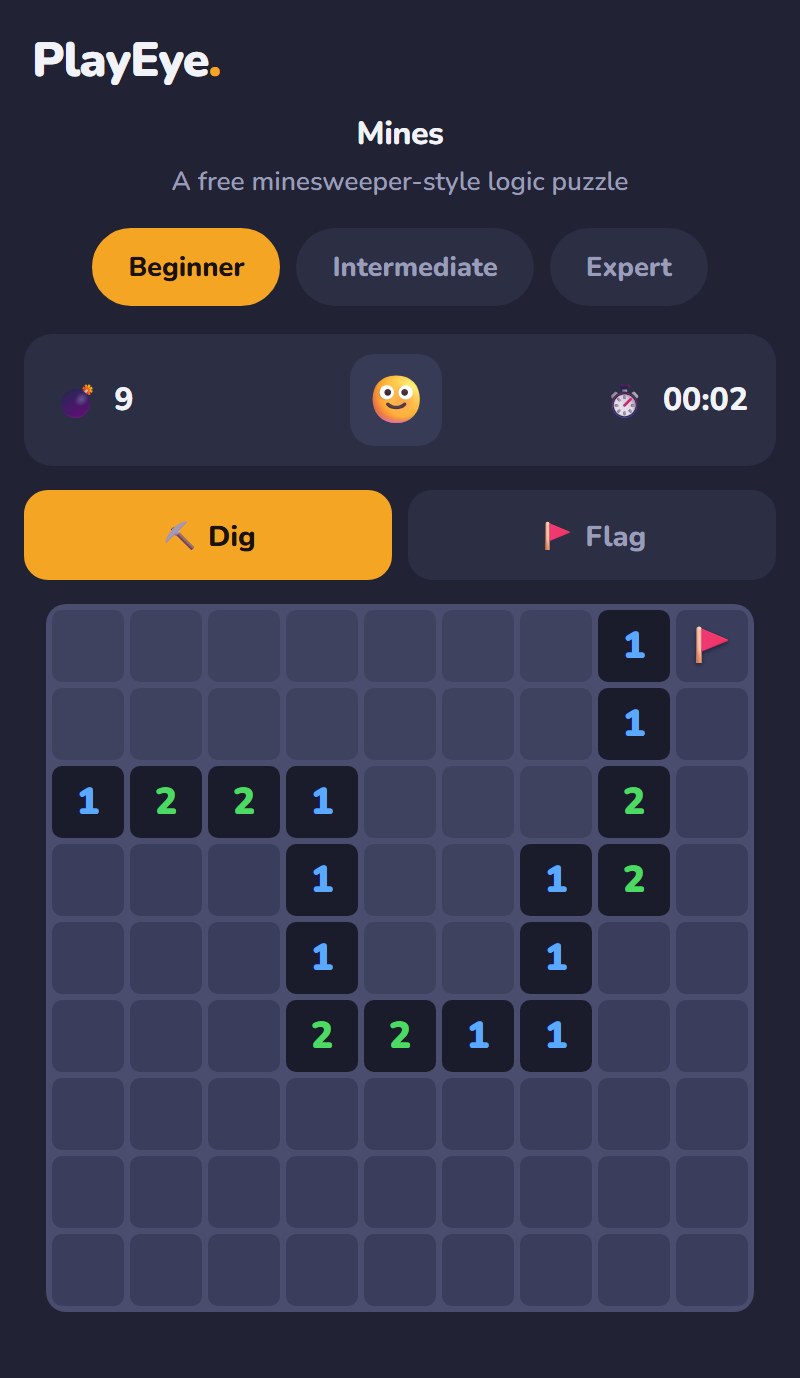
Mines is a logic puzzle wearing the clothes of a guessing game. The board is a grid of hidden cells, some of them holding a mine. Click a safe cell and it reveals a number telling you how many mines touch it; click a mine and the run is over. From those numbers alone — no luck required, most of the time — you reason out exactly where the mines sit and clear everything that isn't one.
This is a free, minesweeper-style logic puzzle you can play online free with nothing to install. Three classic board sizes give you a clean difficulty curve: Beginner at 9×9 with 10 mines, Intermediate at 16×16 with 40 mines, and Expert at 16×30 with 99 mines. Your first click is always safe — the board arranges itself so your opening tap never lands on a mine, so every game starts with real information instead of a coin flip. Long-press to plant a flag where you've deduced a mine, and use a chord click on a satisfied number to clear its remaining neighbors in one move. The game keeps your best time for each board, turning a careful solve into a speed puzzle once you trust your reading.
How to Play
- Reveal a cell by tapping it. A number shows how many mines sit in the eight cells around it; a blank means zero, and the board auto-opens the empty area around it.
- Your first click is safe — it will never be a mine, and it usually opens a useful chunk of the board to start your deductions.
- Flag a suspected mine with a long press. Flags are your notes; they mark cells you've reasoned are unsafe so you don't click them by accident.
- Clear the board by revealing every cell that is not a mine. You don't have to flag all the mines to win — you have to open everything else.
- Use a chord click on a number whose flags already match its count, and it instantly reveals all the still-hidden neighbors. It's the fastest way to expand once you've flagged correctly.
- Pick your board before you start: Beginner (9×9, 10 mines), Intermediate (16×16, 40 mines), or Expert (16×30, 99 mines).
Strategy: Reading the Numbers Like a Pro
The whole game is reading the relationship between numbers and the hidden cells they touch. Build these habits and most boards become solvable by pure logic.
- Start with the 1s on the edge of the opened area. A "1" touching exactly one hidden cell tells you that cell is the mine — flag it. A "1" already touching one flag tells you its other hidden neighbors are all safe. The simplest numbers do the most early work.
- Count flags against the number, constantly. The core move of any minesweeper strategy is comparing a number to the flags around it. If a "3" already touches three flags, every other neighbor is safe and can be cleared — that's the moment to chord-click it.
- Open boldly, then flag precisely. New players over-flag and under-open. Flags don't win the game; revealing safe cells does. Flag only what you've actually deduced, and spend most of your clicks opening cells you've proven are clear.
- Work the borders, not the open middle. All the information lives along the frontier between revealed numbers and hidden cells. Scan that border for numbers that are fully "satisfied" (enough flags) or fully "forced" (only as many hidden neighbors as mines remaining).
- Use the 1-2-1 and 1-2-2-1 patterns. Along a straight wall of hidden cells, a row of numbers like 1-2-1 resolves to a fixed mine layout every time — the mines sit under the 1s' outer cells in predictable spots. Memorizing these common edge patterns lets you clear stretches instantly without re-deriving them.
- Subtract overlapping numbers. When two numbers share some hidden neighbors, the difference in their counts often pins down a mine or a safe cell in the non-shared cells. This "set subtraction" is the technique that cracks positions that look like dead ends.
- Track the global mine count near the end. When only a few hidden cells remain, the total mines left versus cells left can force the whole finish — sometimes every remaining cell is a mine, sometimes every one is safe. Don't keep solving locally when the count already answers it.
- When you must guess, guess smart. Rarely, a board leaves a true coin-flip. Prefer guessing in a corner or against a wall where fewer constraints apply, and pick the cell that, if safe, opens the most new information. But check every logical avenue first — most "I have to guess" moments are missed deductions.
- On Expert, manage your time, not just your moves. With 99 mines on a wide 16×30 grid, the win comes from a steady rhythm of read-flag-chord, not heroic individual clicks. Speed records come from never re-checking a number you've already resolved.
Where the Puzzle Came From
The lineage of this kind of grid-deduction game reaches back to mainframe and early computer environments of the 1960s and 70s, where various "find the hidden hazards on a grid" programs circulated long before home computers were common. The exact first version is hard to pin down — these games passed informally between systems and programmers — but the shape of the idea was established well before it reached a mass audience.
The breakthrough into household familiarity came with Microsoft Windows in the early 1990s, when a minesweeper-style game shipped as part of the bundled programs in Windows 3.1 and the releases around it. Like the bundled card game of the same era, it was partly there to give new users a reason to practice precise mouse control — left-click to reveal, right-click to flag. It became one of the most recognized desktop games in the world, the default "quick puzzle" sitting one click away on an enormous number of office computers.
Its reputation as a logic puzzle, rather than a luck-based one, grew alongside a community of players who proved how much of the board can be solved by deduction and who chased ever-faster completion times. Modern web versions like this one preserve that core — number-reading, flagging, chording — while adding conveniences the originals lacked, most notably the guaranteed safe first click that turns the opening from a gamble into a genuine start.
Frequently Asked Questions
What's the best first move?
There isn't a single magic cell — because the first click is guaranteed safe, almost any opening works. Many players click near a corner or edge, since those cells touch fewer neighbors and tend to produce cleaner numbers to reason from. The goal of the first click is just to open a chunk of board and get your first real information.
Can I lose on my very first click?
No. The board is arranged so your opening tap is never a mine. That safe start is what makes this a deduction puzzle from move one rather than a roll of the dice.
Do I have to flag every mine to win?
No — you win by revealing every cell that isn't a mine. Flags are an optional aid for keeping track of where you've reasoned the mines are; the game ends in a win the moment all safe cells are open, flagged or not.
What is a chord click and when do I use it?
A chord click is a shortcut on an already-revealed number. Once you've flagged as many neighbors as the number says there are mines, chording that number instantly reveals all its remaining hidden neighbors at once. It's the fastest way to expand the board — but only do it when you trust your flags, since wrong flags will detonate a real mine.
Is the board always solvable without guessing?
Most boards can be solved by pure logic, and with the safe first click you'll rarely face a true gamble. Occasionally a position comes down to a real 50/50, especially late on harder boards — but the vast majority of "forced guesses" turn out to be deductions a player simply missed.
How do the three difficulties compare?
They scale both size and mine density. Beginner (9×9, 10 mines) is room to learn the number-reading without much pressure. Intermediate (16×16, 40 mines) is the standard test. Expert (16×30, 99 mines) is the wide, dense board where pattern recognition and pace decide your best time.