- Genre
- Word Puzzle
- Play time
- 1-3 minutes per puzzle
- Best for
- A daily brain-tickle
- Platform
- Mobile web, no install
About
You stare at 🍯🐝 for a second too long. Honey. Bee. Honey… bee. Honeybee. You type it, the tiles snap green, and the next puzzle is already up: 🔥🚒. Fire. Truck. Got it. You weren't taught any of this — you just read the pictures the way you read a face, and your brain handed you the word before you finished thinking it. That little click, that "oh, obviously" — that's the entire game, fired off a few hundred times.
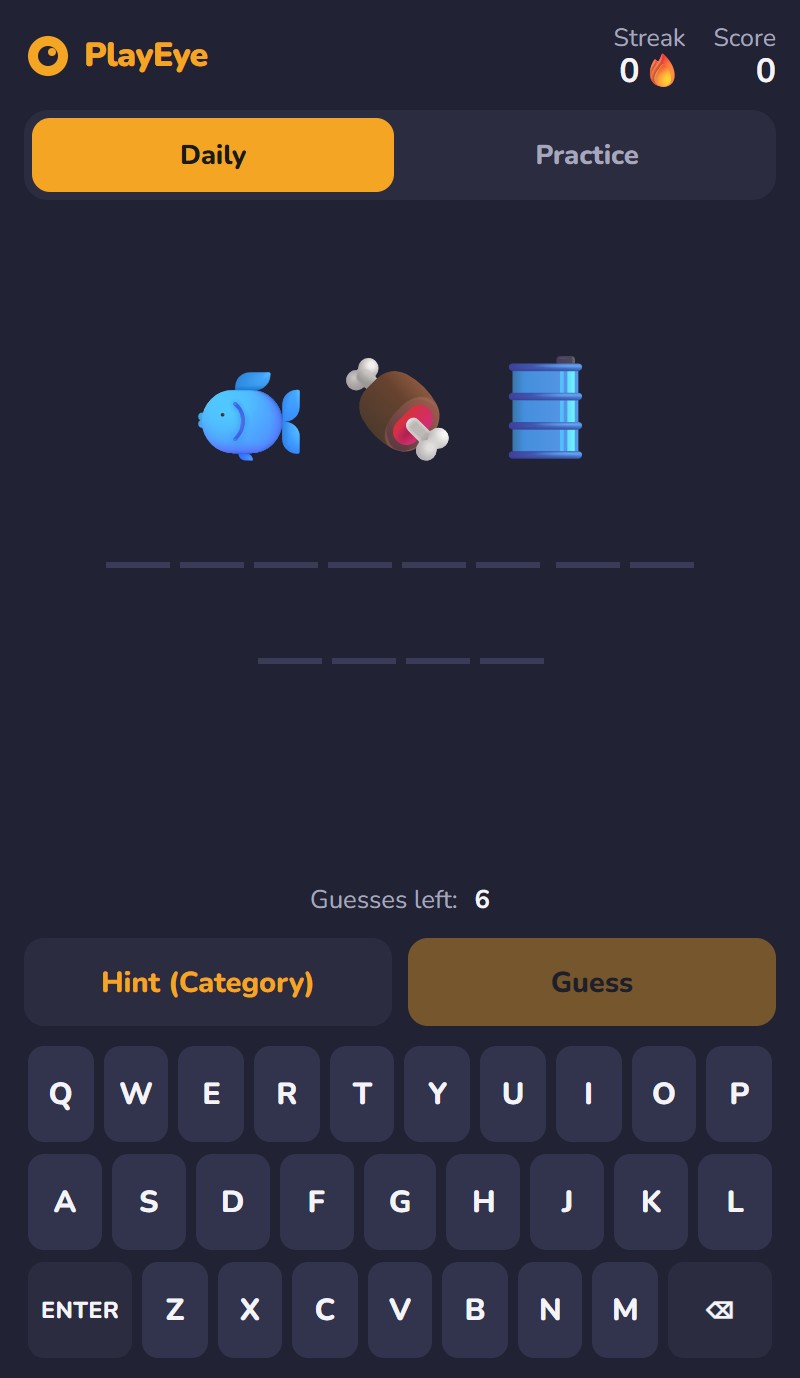
It's a word puzzle, but you never guess letters. You read emoji. Two to four of them sit in a row, and together they spell out a single word or short phrase. Your job is to translate the pictures back into the thing they point at, type it, and move on. Some are a gimme. Some make you say the emoji out loud like a lunatic until the sound turns into a word. That's the fun.
Short answer: Emoji Word Quiz is a free daily puzzle where you decode a row of 2–4 emoji into the hidden word or phrase they represent (🍯🐝 = HONEYBEE). There's one new puzzle every day at midnight, plus unlimited practice rounds, and you can play it free in any browser with nothing to download.
How to Play
The whole loop fits in one screen, and you already know most of it.
- Read the emoji as clues, not decoration. Each puzzle shows a small row of emoji — usually two, three, or four. They aren't a mood or a vibe; they're parts of an answer. Sometimes each emoji is a whole word that joins up (🍯 honey + 🐝 bee → HONEYBEE). Sometimes they're sounds you mash together. Sometimes one emoji is the literal thing and the rest just nudge you toward the right meaning of it. The picture is the puzzle — start by naming each emoji plainly, then see what they make side by side.
- Type your answer. Tap the input, type the word or phrase you think the emoji spell out, and submit. Spaces and capitalization don't matter — FIRETRUCK and fire truck both land. If you're wrong, nothing's lost; the puzzle's still there, take another swing.
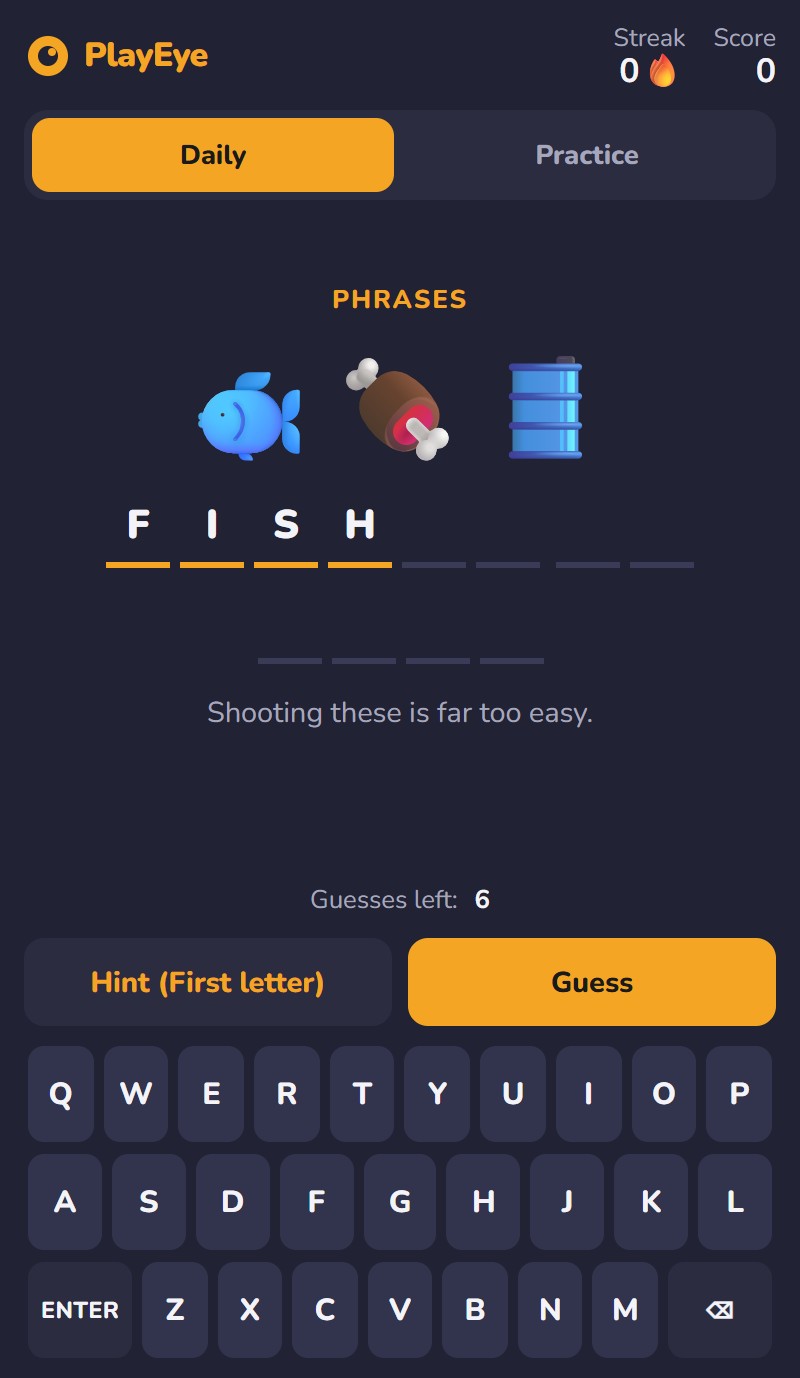
- Use hints when you're truly stuck — but they cost you. Hints come in stages, each one giving away a little more: first the category (is this an animal? a food? a movie?), then the first letter, then more letters filled in one at a time. Every hint you spend trims points off what the puzzle's worth. A clean solve with zero hints is worth the most; lean on the ladder and the score drops with each rung. The hint button is a safety net, not a strategy.
- Play the daily, then practice forever. There's one Daily Puzzle, the same for everyone, reset at midnight — solve it to keep your streak alive and bank your score. When you want more, Unlimited (or Practice) mode serves fresh puzzles back to back with no daily cap, no streak pressure, just reps. The daily is the ritual; practice is where you get fast.
- Share the result, not the answer. Clear the daily and you get a tidy share card — a little grid of emoji that shows how you did without spoiling what it was, the same way the word-guessers do it. Post it, compare with friends, watch them squint.
Strategy: How to Actually Read Emoji Faster
Decoding emoji feels like luck until you notice you're using the same handful of tricks every time. Make them deliberate and the hard ones stop being hard.
- 1. Say it out loud. This is the single most useful habit, and it feels ridiculous, which is why it works. Half of these puzzles are sounds, not meanings — the answer hides in how the emoji names sound mashed together, not in what they picture. 🐝 isn't always "bee" the insect; sometimes it's just the sound "bee." Read the row aloud and your ear catches what your eye missed.
- 2. Break compound words apart. A huge share of answers are two small words stuck together — honey+bee, fire+truck, rain+bow, sun+flower. When you see two emoji that each name a clean little noun, try jamming them into one word before you try anything clever. The obvious join is right more often than it has any business being.
- 3. Name each emoji the most common way first. Every emoji has a "default" reading — 🔥 is fire before it's hot or lit, 💧 is water or drop before it's rain. Start with the plainest name for each, and only reach for the slang or secondary meaning if the plain version goes nowhere. Most puzzles are built on the obvious reading; the clever ones are the exception, not the rule.
- 4. Lean on the category — even before you pay for it. Once a hint hands you the category, it does more work than it looks like: "Movie" turns a vague picture-soup into a shortlist of titles, "Food" rules out half the dictionary. But you can often guess the category for free from the emoji themselves — a row that's all animals is probably an animal answer. Decide what kind of thing you're looking for, then the emoji just have to confirm it.
- 5. Mind the emoji that always mean one thing. Some emoji are near-idioms in these puzzles. ❤️ tends to mean "love" or "heart," 👁️ often stands in for "I" or "eye," 🐝 frequently means "be," 🌊 leans "sea"/"see," 👂 means "ear" or "hear." Build a little mental dictionary of these reliable stand-ins and a lot of phrase puzzles crack on sight.
- 6. Count the emoji, then count the words. Two emoji usually means a two-part answer — one compound word or two short words. Four emoji is rarely four separate words; it's often a phrase where some emoji carry sound and others carry meaning. Let the number of pictures shape how big an answer you're hunting for before you start guessing.
- 7. Read left to right, but check the whole row first. The emoji are usually in answer order, so reading left to right is the right instinct. But scan the full row before you commit to the first emoji's reading — the last emoji often tells you which meaning the first one needs. 🍯🐝 only resolves to "honeybee" once you've clocked that the bee is the second half, not a verb.
- 8. Don't burn a hint on the first stuck moment — sit with it. The cheapest points you'll ever lose are the ones you give away two seconds before you'd have cracked it anyway. When you stall, run the checklist — say it aloud, split the compound, swap to a secondary meaning — before you tap for the category. Hints are for the genuinely opaque puzzles, not the impatient moment.
Frequently Asked Questions
How do you play Emoji Word Quiz?
You're shown a row of 2–4 emoji that together stand for a hidden word or phrase, and you type what they spell out — 🍯🐝 is honeybee, 🔥🚒 is firetruck. Spaces and capitals don't matter. Read each emoji plainly, try joining them into a compound word, and say the row out loud if you're stuck, since many answers are sounds rather than meanings. Stuck for real? Spend a staged hint — category, then first letter, then more — knowing each one trims your score.
What is the daily emoji game?
It's one puzzle a day, the same for every player, that resets at midnight. Solving the Daily Puzzle keeps your streak going and logs your score, which is the whole ritual — a quick, shareable brain-tickle you do once and compare with friends. When one a day isn't enough, Unlimited / Practice mode hands you fresh emoji puzzles with no cap and no streak on the line.
What does it mean when emoji spell a word?
These puzzles use emoji three ways. Some emoji are a whole word that joins with its neighbor (honey 🍯 + bee 🐝 → honeybee). Some stand for a sound that you blend with the others — 🐝 read as "be," 👁️ read as "I." And some are the literal thing they show, with the surrounding emoji telling you which meaning to use. The trick is figuring out which of the three a given emoji is doing — and saying the row aloud usually reveals it.
Are the hints worth using?
They're worth it when you're genuinely stuck, not when you're just impatient — because they cost you points on a sliding scale. The first hint gives the category, the next the first letter, then more letters one at a time, and your score drops with each step. A zero-hint solve is the high score; a fully-hinted one barely registers. Treat hints as a way to keep a hard puzzle moving rather than a shortcut on an easy one.
Is Emoji Word Quiz free, and do I need to download it?
It's free and there's nothing to install — it runs right in your browser on phone or desktop, so it's a true emoji puzzle game, free and no download required. Your streak and progress save locally in the browser, no account needed. It lives on PlayEye next to our other word and brain games, including the daily letter-guesser WordPlay if you like a five-letter puzzle, plus number-logic picks like Sudoku and Mines when you want to switch the part of your brain you're using.